One 80 lb bag of concrete mix makes 0.60 cubic feet of mixed, placed concrete. A 60 lb bag makes 0.45 cubic feet. A 50 lb bag makes 0.375 cubic feet, the answer for the most-searched size.
A 40 lb bag makes 0.30 cubic feet. Every project calculation starts from that wet yield, not the weight on the bag.
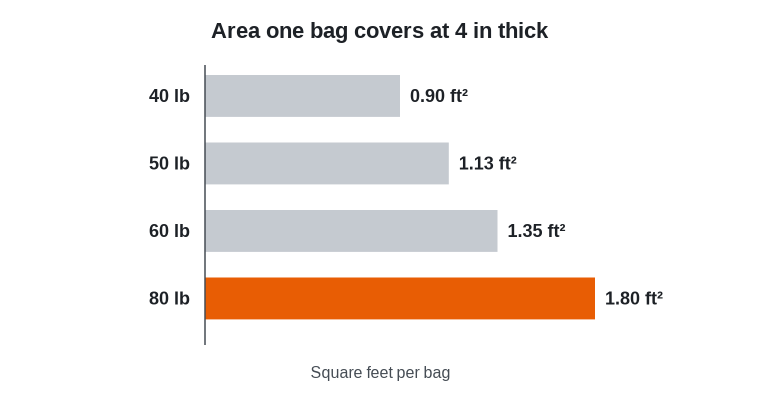
Coverage follows directly from yield. At the common 4 in slab thickness, one 80 lb bag covers about 1.8 square feet. Bagged concrete is a small-volume material, and understanding exactly how small keeps a project from running short mid-pour.
Run your own dimensions through the concrete bag calculator once you have the tables below in hand.
Yield table: what each bag actually makes #
Yield means the volume of finished concrete one bag produces after mixing with water and placing. Manufacturers state the yield on the bag. These are the standard figures for regular concrete mix.
| Bag size | Wet yield |
|---|---|
| 80 lb | 0.60 ft³ |
| 60 lb | 0.45 ft³ |
| 50 lb | 0.375 ft³ |
| 40 lb | 0.30 ft³ |
Every bag calculation follows the same two steps. First, work out the volume your project needs in cubic feet. Then divide by the yield of your bag and round up to a whole bag.
A project needing 3 cubic feet takes 5 bags of 80 lb mix. It takes 7 bags of 60 lb mix, rounding 6.67 up, or 8 bags of 50 lb mix. The project volume never changes.
Only the number of trips to the stack changes to reach that volume.
Coverage table: yield at real thicknesses #
For flat work, coverage is the more useful way to picture a bag. Coverage equals yield divided by thickness. The thinner the pour, the more area one bag covers.
| Bag size | 2 in thick | 3 in thick | 4 in thick | 6 in thick |
|---|---|---|---|---|
| 80 lb | 3.6 ft² | 2.4 ft² | 1.8 ft² | 1.2 ft² |
| 60 lb | 2.7 ft² | 1.8 ft² | 1.35 ft² | 0.9 ft² |
| 50 lb | 2.25 ft² | 1.5 ft² | 1.125 ft² | 0.75 ft² |
| 40 lb | 1.8 ft² | 1.2 ft² | 0.9 ft² | 0.6 ft² |
Read the 4 in column carefully. Four inches is the standard thickness for patios, walkways, and many pads. Even the largest bag covers less than 2 square feet at that thickness.
A modest pad therefore runs to dozens of bags very quickly. That count is not an argument against bags. It is an argument for doing this multiplication at the kitchen table, not in the driveway with forms already built.
Thickness errors are the most expensive coverage errors. Pouring at 6 in where you estimated 4 in does not add a little concrete. It adds half as much again.
Measure your formed depth in several places and use the real figure in the table. An uneven base makes parts of the pour thicker than the forms suggest.
Why the dry bag looks bigger than the yield #
If you pour a dry bag into a box, an 80 lb bag occupies roughly half a cubic foot of loose material. The stated yield describes the finished volume instead. The loose dry volume and the wet yield do not match in the simple way people expect.
Voids and compaction explain the gap.
Dry mix holds air gaps between grains of sand and pieces of stone. Adding water and mixing lets finer material and water fill those gaps. The blend consolidates into a dense, compacted mass.
Placed concrete traps far less air than the loose pile you started with. Weight and chemistry change hands during mixing. No tidy one-to-one volume swap occurs.
Never estimate a job from the apparent bulk of dry bags. Never assume water adds its full volume on top.
Trust the manufacturer's wet yield figure: 0.60, 0.45, 0.375, 0.30 cubic feet. That volume is what actually stands in your forms after mixing and placing.
Three real jobs, costed in bags #
A small patch, 2 ft by 2 ft at 4 in thick. The volume is 1.33 cubic feet. Dividing by 0.60 gives 2.22, so the job needs 3 bags of 80 lb mix.
The third bag gives you the working surplus a patch needs for an uneven base. This is the natural home territory of bagged concrete. No truck would deliver for an hour's job like this.
A mailbox post hole, 10 in in diameter and 2.5 ft deep. A round hole that size holds 1.36 cubic feet. That equals 3 bags of 80 lb mix, rounding up from 2.27.
This figure uses the full hole volume. A post sitting in the hole displaces a little of it. That displacement conveniently covers the rounding, and how many bags for fence post holes covers more post-hole sizes.
Stepping stones, 12 in in diameter and 2 in thick. One stone takes just 0.13 cubic feet. One 80 lb bag at 0.60 cubic feet therefore makes 4 to 5 stones.
This batch project makes a single bag a sensible purchase. The molds, not the concrete, set the pace.
The pattern across all three jobs is consistent. Work out the volume honestly, divide by yield, and round up.
Every job here is small in cubic feet and entirely reasonable in bags. Apply exactly that test to your own project.
Scaling up: from bags to cubic yards #
Ready-mix concrete is sold by the cubic yard. One cubic yard equals 27 cubic feet. At 0.60 cubic feet per bag, filling a cubic yard from bags takes 45 bags of 80 lb mix.
That single conversion explains the whole bags-versus-truck landscape.
A job needing half a cubic yard already reaches the low twenties of bags. A job needing several yards reaches the hundreds of bags. Mixing time, physical effort, and batch-to-batch consistency then argue for a delivery, even before price enters the decision.
Use the yard conversion early in planning: divide your volume in cubic feet by 27. If that number makes you wince, get a ready-mix quote and compare it honestly against the bag count. The framework in how much concrete do I need guides that comparison.
For patches, post holes, and small pours, the bag is the most flexible concrete supply available. Bags carry no minimum order, no delivery window, and no clock.
The skill is knowing, in cubic feet, which side of the line your project sits on. The four yield numbers above decide that line.