Concrete Bag Calculator
Enter the size of your pour and this bag concrete calculator tells you how many pre-mix bags to buy. It reports all four standard sizes: 40, 50, 60, and 80 lb. You can compare what sits on the store shelf instead of guessing in the aisle.
Free · Instant results as you type · No sign-up
Live preview
Your estimate
Updates as you typeIncludes a 5% waste allowance on top of the exact geometric volume (1.23 yd³). Bag counts are rounded up, because you cannot buy part of a bag.
The tool suits the jobs bags actually handle: post holes, small pads, walkways, patches, and footings under a cubic yard. As a bagged concrete calculator, it assumes pre-mix sacks throughout, not site-mixed concrete.
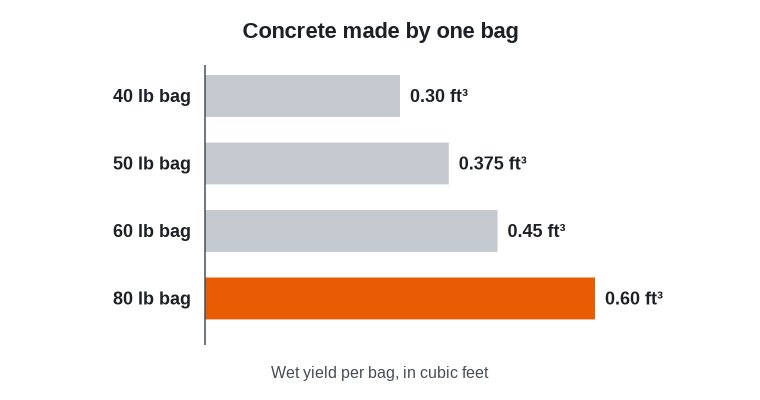
Stores sell bags by weight, but crews place concrete by volume, and each bag's yield fixes the conversion. An 80 lb bag of Quikrete or Sakrete pre-mix makes 0.60 cubic feet of wet concrete. A 60 lb bag makes 0.45 ft³, a 50 lb bag 0.375 ft³, and a 40 lb bag 0.30 ft³.
Every count here divides your pour's volume by that yield and rounds up, because no one can split a bag across trips to the store. That single yield answers the most common bag question, how many 80 pound bags of concrete in a yard: 27 ÷ 0.60 = 45.
How This Calculator Works
A bags of concrete calculator first works out your pour's volume in cubic feet. It multiplies length × width × thickness, converts inches to feet, and adds your waste allowance. Then it divides by the yield of each bag size and rounds counts up to whole bags.
Regional names change nothing. Whether you think of it as a sack concrete calculator or a bag calculator, the yields below are the whole method.
The practical limit for bags is about one cubic yard. One yard is 45 × 80 lb bags. A small crew with a rented mixer can handle that load in a heavy Saturday.
Two yards is 90 bags and roughly 7,200 lb of dry mix. Someone must lift, open, mix, and place all of it before the first batches start to set. Past one yard, a ready-mix truck is almost always cheaper per cubic foot and produces more consistent concrete.
For pallet orders, standard counts are 42 bags for 80 lb and 56 for 60 lb. Counts run 64 for 50 lb and 80 for 40 lb. A pallet of 80 lb bags weighs about 3,360 lb plus the pallet, so plan the vehicle or delivery accordingly.
Formula: Bags needed = (Length × Width × Thickness in ft³) × (1 + waste %) ÷ yield per bag (80 lb: 0.60 ft³, 60 lb: 0.45 ft³, 50 lb: 0.375 ft³, 40 lb: 0.30 ft³)
Worked Example: Bags for a 10 × 10 ft slab, 4 in thick
- Volume: 10 × 10 × (4 ÷ 12) = 33.33 ft³, or 1.23 yd³.
- 80 lb bags: 33.33 ÷ 0.60 = 55.6, rounded up to 56 bags.
- 60 lb bags: 33.33 ÷ 0.45 = 74.1, rounded up to 75 bags.
- 50 lb bags: 33.33 ÷ 0.375 = 88.9, rounded up to 89 bags.
- 40 lb bags: 33.33 ÷ 0.30 = 111.1, rounded up to 112 bags.
Result: 56 × 80 lb bags give the fewest trips and usually the lowest cost per cubic foot. The smaller sizes take 75, 89, or 112 bags.
Bags of Concrete per Cubic Yard, and Coverage per Bag
| Bag size | Yield per bag | Bags per cubic yard | Coverage at 4 in thick | Bags per pallet |
|---|---|---|---|---|
| 40 lb | 0.30 ft³ | 90 bags | 0.90 ft² | 80 bags |
| 50 lb | 0.375 ft³ | 72 bags | 1.13 ft² | 64 bags |
| 60 lb | 0.45 ft³ | 60 bags | 1.35 ft² | 56 bags |
| 80 lb | 0.60 ft³ | 45 bags | 1.80 ft² | 42 bags |
Frequently Asked Questions
How many 80 lb bags of concrete are in a cubic yard?
Forty-five: one cubic yard is 27 ft³, and an 80 lb bag yields 0.60 ft³, so 27 ÷ 0.60 = 45. The same yard takes 60 × 60 lb bags, 72 × 50 lb bags, or 90 × 40 lb bags. To answer how many 80 lb bags of concrete in a yard of any shape, divide the pour's cubic feet by 0.60.
How many bags of concrete are on a pallet?
An 80 lb pallet holds 42 bags, a 60 lb pallet 56, a 50 lb pallet 64, and a 40 lb pallet 80. If you count how many 80 lb bags of concrete on a pallet for a delivery or truck bed, the answer is 42. That pallet holds roughly 3,360 lb of mix, plus the pallet itself.
How much does a bag of concrete cost?
A standard 80 lb bag of pre-mix typically runs about $4 to $7 at US home centers. Bags of 60 lb run about $4 to $6, 40 lb bags about $3.50 to $5, and fast-setting or high-strength mixes cost more. The 80 lb bag of concrete price per cubic foot is the lowest, but bag of concrete cost is only half the comparison.
How many bags of concrete do I need for a 10×10 slab?
At 4 in thick (33.33 ft³), you need 56 × 80 lb bags or 75 × 60 lb bags before waste. The smaller sizes take 89 × 50 lb or 112 × 40 lb bags. That is over a yard of concrete, so compare the bag total against a ready-mix delivery before you commit.
How much water goes in each bag?
Roughly 3 quarts for an 80 lb bag, scaling down with bag size (about 2 quarts for 60 lb). Start below the bag's stated maximum and add small amounts. Soupy concrete loses strength fast, because excess water raises the water-cement ratio.
Are bag counts different for Quikrete and Sakrete?
No. Both brands rate standard pre-mix bags at the same yields: 0.60 ft³ (80 lb), 0.45 (60 lb), 0.375 (50 lb), and 0.30 (40 lb). High-strength and crack-resistant mixes use the same yields; fast-setting mixes are very close.
When should I stop using bags and order ready-mix?
Stop around one cubic yard: below that, bags win on convenience and minimum-order fees. Above it, labor, mixer rental, and the inconsistency of hand mixing cost more than a short-load delivery. A truck places the whole pour at once, which means no cold joints.
Related Calculators
Helpful Guides
Concrete Bags
How Many Bags of Concrete in a Yard? (40/50/60/80 lb Chart)
How many 80 lb bags of concrete in a yard? One cubic yard takes 45 bags of 80 lb mix. See charts for 40, 50, and 60 lb bags and costs.
Read guideConcrete Bags
How Many Bags of Concrete on a Pallet?
How many bags of concrete on a pallet? A pallet holds 42 bags of 80 lb mix, 56 of 60 lb, 64 of 50 lb, or 80 of 40 lb. See weights.
Read guideConcrete Bags
Choosing the Right Concrete Bag: 40 vs 50 vs 60 vs 80 lb
Bigger bags are cheaper per cubic foot: 80 lb mix runs about $9 per cubic foot vs $15 for 40 lb bags. Handling, mixer batches, and specialty bags compared.
Read guideConcrete Bags
How Much Concrete Does One Bag Make? Yield & Coverage Explained
How much concrete does a 50 lb bag make? One 50 lb bag makes 0.375 cubic feet. See yield and coverage tables for every bag size.
Read guideMix & Materials
How Much Water for a Bag of Concrete?
An 80 lb bag of concrete mix needs 3.5 quarts of water; 60 lb about 2.5 to 3 quarts. Full chart, the gradual-add method and why extra water kills strength.
Read guide