The right concrete bag is usually the biggest one you can safely handle. An 80 lb bag yields 0.60 cubic feet and, at typical prices, costs about $9.17 per cubic foot. A 40 lb bag yields 0.30 cubic feet and costs about $15.00 per cubic foot.
Same class of mix, very different price for the concrete itself. That does not make 80 lb bags right for everyone. Weight you cannot move safely is not a saving, and small jobs and specialty mixes change the answer.
This guide compares the four sizes on yield, cost, handling, and mixer fit, then decodes the specialty bags. For bag counts, use the concrete bag calculator.
The four sizes, and who each one is for #
All four sizes below are the same general-purpose kind of mix in different amounts. What changes is yield per bag, and therefore how many bags a job takes and how many times you lift, carry, and open.
| Bag size | Yield per bag |
|---|---|
| 40 lb | 0.30 ft³ |
| 50 lb | 0.375 ft³ |
| 60 lb | 0.45 ft³ |
| 80 lb | 0.60 ft³ |
The 80 lb bag is the default for able-bodied crews, mixer work, and any job measured in dozens of bags. Footings, slabs, and wall pours all let its cost advantage multiply across the whole purchase.
The 60 lb bag is the compromise size, and a genuinely sensible one. It yields three-quarters of an 80 lb bag in a package many people find noticeably more manageable. It also pairs well in mixers, as the logistics section below explains.
The 50 lb bag is the specialty-bag size as much as a general size. Manufacturers sell fast-setting mixes predominantly at this weight, so post-hole work often lands here whether you chose it or not. As a general mix it suits smaller jobs and anyone working alone at a steady pace.
The 40 lb bag is the convenience size. Choose it for a single small repair, for carrying mix up stairs, and whenever heavier bags are not a safe lift.
Paying more per cubic foot for one or two bags is rational. Paying it across a patio is not.
Cost per cubic foot: what small bags really cost #
Shelf prices make small bags look cheaper. Price per cubic foot of finished concrete tells the truth. The figures below use typical prices, so check your local shelf before you buy.
| Bag size | Typical price | Yield | Cost per ft³ |
|---|---|---|---|
| 80 lb | $5.50 | 0.60 ft³ | $9.17 |
| 60 lb | $5.00 | 0.45 ft³ | $11.11 |
| 50 lb | $4.75 | 0.375 ft³ | $12.67 |
| 40 lb | $4.50 | 0.30 ft³ | $15.00 |
The 40 lb bag costs roughly 60% more per cubic foot than the 80 lb bag. On a two-bag repair, that premium is pocket change and not worth a strained back.
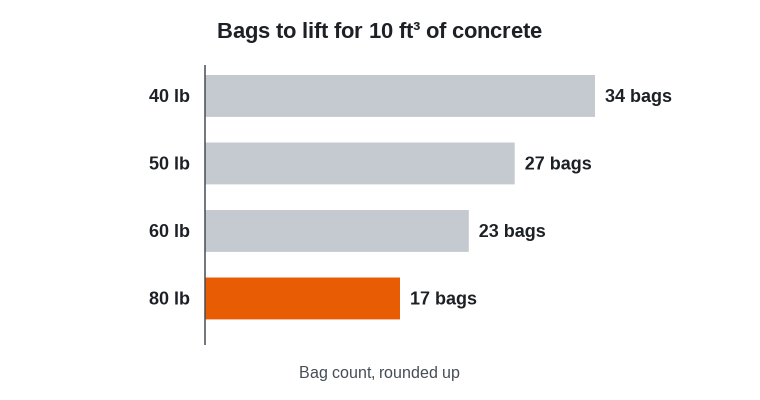
On a job needing 10 cubic feet of concrete, the same choice means about 17 large bags or about 34 small ones. The small-bag route costs substantially more money and exactly twice the handling.
Run the comparison on your own job volume before you shop. Work out the cubic feet first, and price the job in each size you could realistically handle. Let that total, not the single-bag shelf price, drive the decision.
The yield figures behind this table are explained in how much concrete one bag makes.
Handling and mixing logistics #
An 80 lb bag is a two-handed deadlift, repeated for every bag in the job. It sits at the edge of what most people can lift safely alone. That is especially true the twentieth time, on uneven ground, at the end of a pour.
Be honest about this at the planning stage. A crew of two, a wheelbarrow staged at the vehicle, and bags placed along the work before mixing starts all make the big-bag choice realistic. Working solo with a long carry makes the 60 lb bag the smarter buy, whatever the cost table says.
Mixer capacity points the same way. A typical 3.5 cubic foot rental drum mixer comfortably handles one 80 lb bag per batch, or two 60 lb bags per batch. Those figures are typical working loads, not the drum's brim-full volume, because a mixer needs room to tumble the load rather than slosh it.
The two-60 lb batch is a favorite for a reason: it produces more concrete per batch cycle while keeping each individual lift lighter. Hand-mixing in a wheelbarrow or tub argues even more strongly for smaller batches and smaller bags. The person stirring is also the person who lifted the bag.
Plan the whole chain before you choose a size: vehicle to staging, staging to mixer, mixer to forms.
Specialty mixes, decoded #
Beyond general-purpose mix, the bag aisle holds specialty products that cost more and earn it only in their specific situations.
Fast-setting mix sets in about 20 to 40 minutes. You place it dry and water it in the hole, with no pre-mixing. For fence and mailbox posts it is worth every cent of its premium, as bags for fence post holes covers.
For flat work it is a liability, because you cannot finish a slab against that clock.
High-strength 5,000 PSI mix serves work that genuinely needs the strength: structural repairs and applications a specification calls out. For ordinary pads and posts, general-purpose mix already does the job. Paying for strength you will never load is waste.
Crack-resistant, fiber-reinforced mix includes fibers that help control small shrinkage cracking. It is a reasonable upgrade for thin slabs and visible flat work where surface appearance matters. It is not a substitute for proper joints and curing.
Sand and topping mixes contain no coarse aggregate, which is exactly why they exist. Repairs and overlays thinner than 2 in need sand mix, because the stone in regular mix cannot fit or finish properly at that depth. Using regular concrete mix for a thin patch is a category error, not a saving.
The rule for all four is simple. Pay for a specialty bag when your job matches its one specific advantage. Buy general-purpose mix, in the biggest size you can handle, for everything else.
Storage and shelf life #
Whichever size you choose, bagged mix is perishable in a quiet way. Bags store best indoors, off the floor on a pallet or boards, kept dry and out of humid air.
A bag that has taken on moisture may feel lumpy or partly hardened before you open it. Mix with hardened lumps will not reach its stated strength. Set bags in that condition aside rather than burying them in structural work.
Buy close to the pour date when you can. Rotate stock so you use older bags first, and keep unopened extras dry so they remain returnable.
If storage and staging become a logistics problem in themselves, revisit whether bags are the right supply at all. See how much concrete do I need.
Choose by the chain of work, not the shelf tag. Pick the biggest bag you can lift safely all day. Buy general-purpose mix unless a specialty advantage matches your job, and store every bag dry until you open it.