Concrete Cost Calculator
This concrete cost calculator turns a slab's length, width, and thickness into a material budget. It is the concrete price calculator to reach for before a quote goes out. The budget covers ready-mix yards, your price per yard, your waste allowance, and any delivery or short-load fee in one total.
Free · Instant results as you type · No sign-up
Live preview
Your estimate
Updates as you typeIncludes a 10% waste allowance on top of the exact geometric volume (4.94 yd³). Bag counts are rounded up, because you cannot buy part of a bag.
You need this number before calling plants for quotes. Quotes are only comparable when they price the same yardage.
Concrete is sold by the cubic yard, not by the square foot. Two driveways with the same area can cost very different amounts. A 6 in slab uses 50% more concrete than a 4 in slab on the same footprint.
This calculator converts thickness from inches to feet before any math happens. It adds waste separately so you can see it. You can change the price per yard to match your local plant instead of a national average.
How This Calculator Works
The volume math is the slab formula: length × width × thickness, all in feet, divided by 27 for cubic yards. The cost math multiplies that yardage by the price per cubic yard you enter. It applies your waste percentage first and adds any flat delivery fee on top.
That separation matters because waste and delivery are real costs that a simple price per yard figure hides. In short, the concrete calculator price you get out is only as good as the local rate you put in.
Ready-mix pricing has two traps this calculator is built to expose. First, plants bill in quarter-yard steps, so 5.43 yd³ is billed as 5.5 yd³.
Second, most plants set a minimum load, commonly 4 to 6 yd³. Order less and the plant adds a short-load fee of $40 to $100 for running a truck mostly empty. A small patio can therefore cost noticeably more per yard than a full truckload, even at the same posted price.
Bagged pre-mix is the alternative for very small jobs. An 80 lb bag yields 0.60 ft³ of concrete and typically costs $4.50 to $6.50, far more per cubic yard than ready-mix. But bags carry no delivery fee, no minimum load, and no short-load penalty.
Below roughly half a cubic yard, bags usually win on total cost. Above a full yard, ready-mix is almost always cheaper and far less labor.
Formula: Cubic yards = Length × Width × Thickness (all in feet) ÷ 27 · Total cost = Cubic yards × (1 + waste %) × price per yd³ + delivery fee
Worked Example: A 20 × 20 ft garage slab, 4 in thick
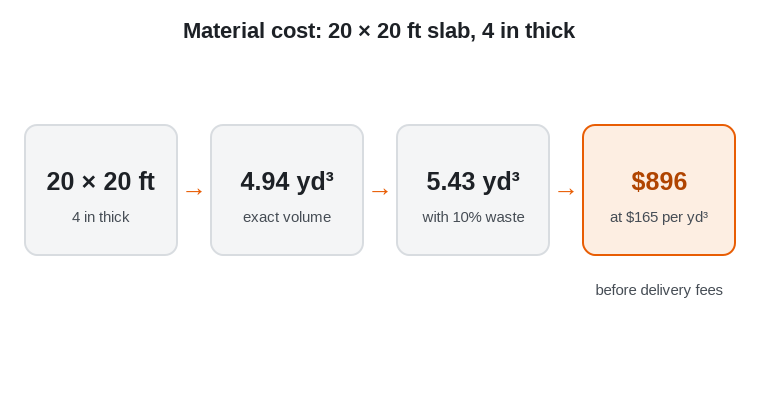
- Convert the thickness: 4 in ÷ 12 = 0.333 ft.
- Multiply: 20 ft × 20 ft × 0.333 ft = 133.33 ft³.
- Convert to yards: 133.33 ÷ 27 = 4.94 yd³ exact.
- Add 10% waste: 4.94 × 1.10 = 5.43 yd³ to order.
- Price it: 5.43 yd³ × $165 per yd³ = $896.30 in material.
- In practice, the plant rounds to quarter yards, so it bills you for 5.5 yd³, or $907.50. Because 5.5 yd³ clears most minimum loads, no short-load fee should apply.
Result: 4.94 yd³ exact and 5.43 yd³ with 10% waste cost $896.30 at $165/yd³. The plant bills $907.50 in quarter-yard steps.
Typical 2026 US price ranges
| Item | Typical range | Notes |
|---|---|---|
| Ready-mix, per cubic yard delivered | $150 to $200 | Varies by region, mix strength (PSI) and haul distance; coastal metros run high, rural plants low. |
| Short-load fee | $40 to $100 | Added when the load is below the plant minimum, commonly 4 to 6 yd³. |
| Bagged pre-mix, 80 lb bag | $4.50 to $6.50 | Yields 0.60 ft³ per bag; pallet pricing at home centers can beat the single-bag price. |
| Mixer rental, per day | $50 to $90 | Electric or tow-behind mixers; makes bagged concrete practical up to about 1 yd³. |
| Pump hire, per day | $800 to $1,200 | Line or boom pump for pours a truck chute cannot reach; often billed with a minimum of several hours. |
| Delivery fee | $0 to $150 | Some plants include delivery inside a radius and charge beyond it; enter yours above if quoted separately. |
Frequently Asked Questions
What is the average cost of concrete per cubic yard in 2026?
Delivered ready-mix typically runs $150 to $200 per cubic yard in the US in 2026, with $165 a reasonable mid-range planning figure. The price covers the material and standard delivery inside the plant's local radius; taxes, fuel surcharges, short-load fees and pump hire are extra.
How much does concrete cost per square foot installed?
For a basic broom-finished slab hired out, figure $6 to $12 per square foot installed, including forms, placement and finishing. Stamped, colored or exposed-aggregate work typically runs $12 to $20 per square foot. Material alone, the number this calculator gives, is only about $2 to $4 of that per square foot at common thicknesses.
Why do concrete quotes vary so much between contractors?
Quotes differ on the things a yardage figure does not show: thickness, PSI, excavation, gravel base depth, and reinforcement in mesh or rebar. Site access, old slab removal, finish type, and short-load or Saturday fees also move the price. Compare quotes only after you confirm each one covers the same scope in writing.
Is bagged concrete cheaper than ready-mix for small jobs?
Yes, on total cost, for very small pours. Twenty 80 lb bags make about 0.44 yd³ and cost roughly $90 to $130, with no delivery or short-load fee. A ready-mix minimum load of the same volume can cost $300 or more with fees, but past about 1 yd³ ready-mix becomes the cheaper option.
Can this work as a concrete foundation cost calculator?
For strip footings, yes: enter the footing as a long, narrow slab. Set length to the total footing run (the wall perimeter), width to the footing width, and thickness to the footing depth. That prices the footing concrete honestly, and you price stem walls and grade beams the same way with wall dimensions, then add the two totals.
What is a short-load fee?
A short-load fee is a surcharge, $40 to $100, that plants add when you order less than their minimum load of 4 to 6 yd³. A truck costs nearly as much to run half-empty, so the fee covers the lost capacity. Ordering a full minimum load, or combining two small pours into one delivery, avoids it.