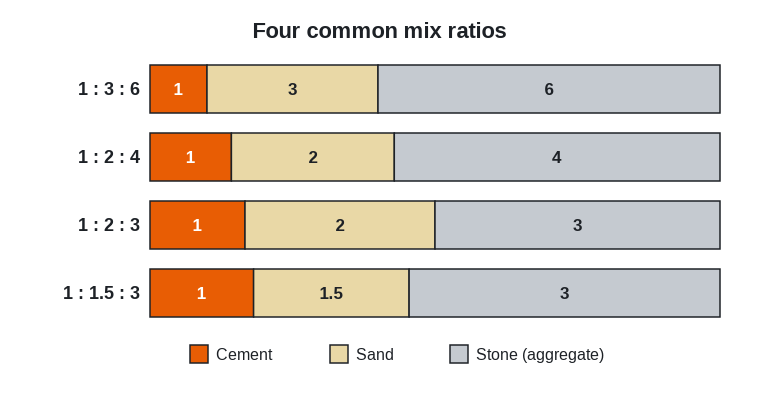
A concrete mix ratio like 1:2:3 means 1 part cement, 2 parts sand and 3 parts aggregate, measured by volume. The most useful all-round mix, 1:2:3, reaches roughly 3,500 PSI and suits slabs, driveways and general work. Leaner mixes trade strength for cheapness, and richer mixes buy strength with extra cement.
If you take one thing from this page, make it this. Within any ratio, the amount of water you add controls the final strength more than anything else.
To turn a ratio into actual buckets and bags for a specific pour, use the concrete mix calculator. The sections below explain what the numbers mean so the calculator's output makes sense.
How to read a mix ratio #
Every concrete mix ratio follows the same order:
cement : sand : aggregate
So 1:2:4 is one part cement, two parts sand (fine aggregate) and four parts gravel or crushed stone (coarse aggregate). The parts are measured by volume: a bucket of cement, two buckets of sand, four buckets of stone. Not by weight, and not by shovelful unless your shovelfuls are unusually consistent (more on that below).
The ratio also implies cement content. Cement is the expensive ingredient, and it generates the strength.
A richer mix like 1:1.5:3 contains more cement per yard and makes stronger concrete. A lean mix like 1:3:6 stretches the cement across far more aggregate.
In proportion terms, 1:2:3 is 1 part cement in 6 total parts, while 1:3:6 is 1 in 10. The cement fraction drops from about 17% to 10%, and the strength drops with it.
Water never appears in the standard ratio, which is a historical accident that causes real damage. Its own section below covers it.
The ratio chart: strength and cement per yard #
Approximate strengths and cement contents for the four ratios you will actually meet, per cubic yard of finished concrete:
| Mix ratio (cement : sand : aggregate) | Approx. strength | Typical uses | 94 lb cement bags per yd³ |
|---|---|---|---|
| 1:3:6 | ≈1,500 PSI | Lean mix, blinding, fill, leveling under slabs | 5 bags |
| 1:2:4 | ≈2,500 to 3,000 PSI | Foundations and footings | 6 bags |
| 1:2:3 | ≈3,500 PSI | General purpose, slabs, driveways, paths | 7 bags |
| 1:1.5:3 | ≈4,000 PSI | High strength, structural and heavy-duty work | 8 bags |
Treat the PSI figures as approximate: they assume correct water content and proper curing. A 1:2:3 mix made soupy can test weaker than a 1:2:4 mix made correctly. The ratio sets the ceiling, and the water decides how close you get to it.
The cement column drives cost. Going from 1:2:4 to 1:1.5:3 raises cement from 6 to 8 bags per yard, a third more of the priciest ingredient.
Specify the ratio the job needs, not the strongest on the chart. Footings gain nothing from 4,000 PSI concrete. A driveway gains little from a lean 1:3:6 that will scale and wear early.
The dry-volume factor: why 1 yard takes more than 1 yard of dry material #
Buy materials by the yard using the ratios above and you will come up short unless you apply the dry-volume factor of 1.54. Dry ingredients do not add up to the wet volume.
Sand settles into the gaps between stones, and cement coats everything and fills voids. The mixed, compacted concrete ends up occupying only about 65% of the loose dry volume you started with. To make 1 yd³ of placed concrete, you need about 1.54 yd³ of dry materials in total.
Worked through for 1:2:3, the parts sum to 6, so cement takes 1/6 of 1.54 yd³, about 0.257 yd³. That amount works out to the 7 bags of cement (94 lb each) in the chart above.
The concrete mix calculator applies the 1.54 factor for you. If you ever do this by hand, never skip it. Skipping it is the classic reason a site mix runs out three-quarters of the way through a pour.
What actually controls strength: the water #
Abrams' law, established over a century ago and never overturned, states that the strength of concrete is governed by the ratio of water to cement. More water per bag of cement means weaker concrete, reliably, predictably and steeply.
- A water-cement ratio of about 0.50 by weight is the right target for general work: workable, placeable, and strong.
- Every extra splash from the hose raises that ratio. A mix made soupy for easy placing can lose a third of its strength. A 3,500 PSI design pours, finishes beautifully, and hardens into 2,300 PSI concrete that spalls and dusts years early.
Excess water does its damage by leaving. Water that hydration does not consume eventually evaporates. It leaves pores that reduce strength, let freeze-thaw water in, and give the surface its dusty, scaling character.
Practical rules that follow:
- Measure the water with a marked bucket. Do not run the hose by feel.
- If the mix is too stiff to place, the fix is mixing longer or (on a designed mix) a plasticizer, not more water.
- Wet concrete should hold its shape on a shovel and slide off slowly, not pour like soup.
The density and load side of these mixes, meaning what the finished concrete weighs, appears in how much concrete weighs.
Batching on site: buckets, shovels and consistency #
Ratios are by volume, and volume batching only works if the unit is consistent. The standard site method is a bucket: pick one bucket, fill it level for every part of every batch, and never switch mid-pour.
Cement from a 94 lb bag is the awkward unit, so most site mixers batch by the bag. One bag of cement comes first, then the matching buckets of sand and stone for the chosen ratio.
Shovel batching is where ratios go to die. A heaped shovel of damp sand can hold nearly twice a level shovel of dry stone. Damp sand also bulks: it occupies more volume than the same sand dry.
If you must batch by shovel, calibrate a full test batch against a bucket once. Write the counts down, and hold them for the whole pour.
Consistency matters as much as the ratio itself: a slab poured from twelve slightly different batches cures in twelve slightly different shades and strengths. One person batching, one recipe, one water measure: that is the whole system.
Pre-mix bags vs site mixing #
Most small jobs never touch a ratio because bagged pre-mix has already applied one. Standard Quikrete and Sakrete pre-mix bags are pre-proportioned mixes, typically in the 4,000 PSI class. They combine cement, sand and aggregate dry, and you add only water.
That buys a tested ratio in every batch and no leftover aggregate piles. Bag counts are in how many bags of concrete are in a yard.
Site mixing earns its keep when the pour is big enough that bags get expensive and slow. It also wins when the pour is too small or too remote for a ready-mix truck. It also wins when you need a specific ratio a bag does not offer, such as a lean 1:3:6 blinding layer.
Between roughly half a yard and a yard and a half, all three options are defensible. Labor and access, rather than the ratio itself, decide between them.
Keep the hierarchy straight. Pick the ratio from the chart, measure dry parts by a consistent volume, and apply the 1.54 dry-volume factor when buying loose materials. Guard the water like it is the main ingredient, because for strength, it is.
The concrete mix calculator turns that into per-batch quantities for your pour.