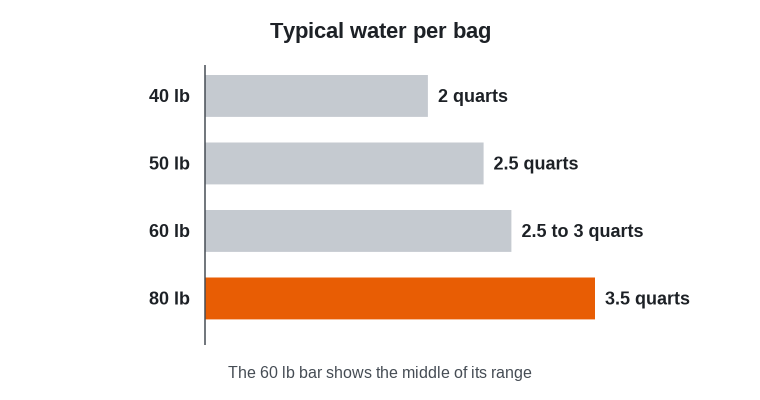
An 80 lb bag of concrete mix needs about 3.5 quarts of water, roughly 0.875 gallons. A 60 lb bag needs about 2.5 to 3 quarts, and a 50 lb bag needs about 2.5 quarts. A 40 lb bag needs about 2 quarts.
These are typical manufacturer figures; the printed instructions on your bag always win if they differ.
That amount looks like far too little water for a heavy bag of dry mix. It is not too little. Concrete should stay stiff.
The single most common DIY concrete mistake is drowning the mix to make it easier to stir and pour. For the bag counts that go with the water, see the concrete bag calculator.
The water chart by bag size #
One quart equals 0.25 gallons, so the gallon figures below simply convert the quart figures. Use them if your bucket carries gallon marks.
| Bag size | Typical water | In gallons |
|---|---|---|
| 80 lb | 3.5 quarts | 0.875 gal |
| 60 lb | 2.5 to 3 quarts | 0.625 to 0.75 gal |
| 50 lb | 2.5 quarts | 0.625 gal |
| 40 lb | 2 quarts | 0.5 gal |
Treat these as starting points, not licenses. Bagged mixes vary between brands and product lines. A high-strength or fast-setting version of the same weight may call for a slightly different amount.
The dry materials themselves also pick up some moisture from the air in storage. That is why every manufacturer prints its own figure on the bag. The method below adds water in two stages instead of all at once for the same reason.
The chart gets you close. The staged add lets you stop at the right consistency for the bag in front of you.
Also count all of the water. If you wet down a mixer or wheelbarrow on a hot day, the mix picks up some of that water too. Hold back the last portion for that reason.
Judge the mix itself, not just the bucket.
Measure properly: a bucket, not a hose #
Quarts separate a correct mix from a ruined one. Nobody can judge a quart by spraying a hose and watching. Measure your water in a graduated bucket or a marked mixing container, every bag, every batch.
This matters most for consistency across a job. A slab, a set of footings, or a run of post holes is only as uniform as its least careful batch. Give the fifth batch a hopeful blast from the hose and it turns out weaker than the first.
It also shrinks differently and may not match in color or finish. Both batches sit in the same pour, right next to each other.
Set up the water before you open the first bag: a marked bucket beside the mixer removes the temptation to estimate mid-batch. A marked bucket also makes multi-bag batches simple. Multiply the per-bag quarts by the number of bags and measure that total.
Still add the total in stages.
The two-stage add: most of the water first #
Put about 80% of the measured water into the mixer or tub first, add the dry mix, and mix until it is evenly wetted. Then add the remaining water gradually, a little at a time, and mix between additions until the consistency is right. Stop there, even if a little measured water is left over.
There are three reasons for staging it this way. Water first means dry mix does not cake onto a dry tub bottom. Mixing before the final add lets the materials absorb water, so what looks too dry at first often comes together on its own.
Adding the last portion gradually is the only direction that works. You can always add more water, and you can never take any out. You can fix a batch that ends slightly stiff in seconds.
Only more dry mix and more water in proportion can rescue a batch that ends soupy, and only if you have spare bags. Otherwise you accept weaker concrete.
Aim for the consistency of thick oatmeal or peanut butter. Properly mixed concrete holds its shape on a trowel and slides off slowly rather than running off. It mounds instead of flattening into a puddle.
It also shows no dry pockets and no standing water. If it pours like soup, it is not concrete mix any more; it is a problem you are about to bury.
Signs of too much and too little water #
Too much water is the expensive error. The water-to-cement ratio is the strength dial for concrete. Only part of the water feeds the chemical reaction.
Every extra quart per bag eventually evaporates out and leaves pores behind. Soupy, over-watered mixes can lose around a third of their rated strength. They also shrink and crack more as they dry.
Their surfaces dust and finish poorly. Over-watered concrete is easier to place and looks fine on the day. The weakness shows up later, as cracks and a soft, wearing surface.
Too little water fails differently and announces itself immediately. Look for dry pockets that never wet out. Expect a crumbly mix that will not consolidate around reinforcement or into corners.
You also cannot finish such a batch properly. Fix it with small, gradual additions, a splash at a time. Never dump in a full extra quart out of frustration.
Weather changes the water picture #
Temperature works on the same batch from both directions. In hot weather, the mix loses water to evaporation and sets faster. Work in the shade where you can and keep materials out of direct sun.
Stay ready to place the batch as soon as you mix it. Do not compensate by mixing it wet. In cold weather, manufacturers commonly recommend warm mixing water.
Warm water keeps the batch from starting out sluggish and cold. Follow the bag's guidance. In both cases, the per-bag water figure stays the starting point.
Weather changes your speed and your water temperature, not your license to flood the mix.
The retempering myth #
Retempering is a related myth. The myth claims a splash of water and a remix can bring stiffening concrete back to life, good as new. For bag work, treat a stiffening mix as a batch to use up quickly or discard, not a batch to revive.
Once concrete begins its initial set, working it again breaks the structure that was forming. Water added at that stage mostly makes the surface sloppy. The body of the mix stays compromised.
Stories about ready-mix trucks adding water on site do not transfer to your driveway. A controlled adjustment under a specification differs from reviving a half-set wheelbarrow load with the hose an hour later. If batches keep stiffening early, switch to smaller batches and add more hands.
Stage bags and water at the pour before you start. See how much concrete do I need for the planning side.
Measure the water, add most of it first, creep up on the rest, and stop at thick oatmeal. That habit does more for strength than any other single thing on this page.