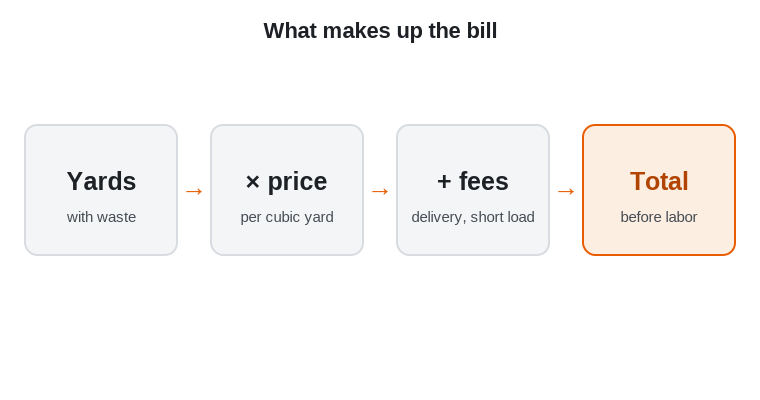
Delivered ready-mix concrete typically costs $150 to $200 per cubic yard in most US markets in 2026. That is the starting point for almost every slab, driveway, footing, and patio budget. Your actual quote will land inside or outside that range depending on strength, distance from the plant, order size, and timing.
If you want a project total instead of a per-yard range, run your dimensions through the concrete cost calculator first. Then compare that estimate to a real plant quote. The per-yard price alone never tells the whole story, because fees and waste change the final bill.
Per-yard price and what moves it #
The base price covers the concrete itself, mixed to a specified strength and delivered within the plant's normal radius. Many plants include delivery within that radius, which is why two quotes for the same yardage can still differ. One plant may include delivery and another may price it separately.
Strength is the first lever. Typical steps add roughly $5 to $15 per 500 PSI, labeled here as typical because plants price their mixes differently.
A standard residential slab mix costs less than a higher-strength mix specified for heavier loads or faster curing. Do not pay for strength you do not need, but do not downgrade a mix your plans or local code require.
Region is the second lever. Cement, aggregate, fuel, and labor costs vary by market, and remote delivery adds time and mileage. A yard delivered a few miles from the plant is a different job from a yard hauled to a rural site with limited truck access.
Season and demand are the third lever. Busy construction periods tighten truck schedules, and cold-weather or hot-weather measures can add cost.
Some plants charge more for weekend delivery, and winter work may need heated water or accelerators. Ask whether your quote assumes a weekday pour during normal hours.
Order size matters as much as any of those factors. A full truck spreads the delivery cost across more yards. A small order concentrates it into fewer yards, which is where short-load fees appear.
The fees nobody warns about #
Short-load fees are the most common surprise. For orders under about 4 to 5 cubic yards, many plants add $40 to $100.
That fee does not mean the plant is overcharging. The truck, driver, and trip cost roughly the same whether the drum carries 3 yards or 9 yards.
Weekend delivery is another common extra. If your help is only available on Saturday, price that choice before you commit. The same applies to early-morning or late placements that fall outside normal dispatch hours.
Plants also charge for extended unload time. Each plant allows a set amount of time on site.
If forms are not ready, access is blocked, or placement runs slow because wheelbarrows have to travel a long distance, the clock keeps running. Clear access, finished forms, and enough help on pour day protect you from this fee.
Washout is a smaller fee that still catches people off guard. The truck has to wash out after discharge, and some plants charge for washout or for an environmental handling process.
Ask whether washout is included, and plan where washout will happen. It should never go into a storm drain or onto ground where runoff will carry it.
Other possible extras include:
- A pump
- Color
- Fiber
- Accelerators
- Extra distance
None of these are hidden if you ask for an itemized quote. The mistake is comparing only the per-yard number from two plants when one quote includes delivery and washout and the other does not.
Per-yard cost in bags for comparison #
Bagged concrete looks cheaper until you convert it to the same unit. One cubic yard of mixed concrete takes 45 bags of 80 lb mix. At $5.50 per bag, that is 45 x $5.50 = $247.50 per yard, before your labor.
That $247.50 is already above the typical $150 to $200 delivered ready-mix range. Then you still have to transport the bags, store them dry, mix them consistently, and place the concrete before early batches start to set.
For a small repair, that trade can make sense. For a full yard or more, the math and the labor both turn against bags quickly.
Bags also create a quality risk on larger pours. Each batch can vary slightly in water content if measuring is casual. Ready-mix arrives as one consistent mix, which matters for strength and finish.
If you are pricing a slab, compare total project cost, not the price of a single bag on a store shelf.
You can check bag counts for your exact dimensions with the guide on how much concrete do I need. Then price both options honestly, including rental equipment and your time.
Total project math: a worked example #
Take a 5 cubic yard garage slab pour as a clean example. Start with the net volume your forms require, then add waste. In the verified example for this site, 5 yards of net need becomes 5.43 cubic yards with waste allowed.
Multiply the waste-adjusted volume by a mid-range price:
| Item | Figure |
|---|---|
| Net concrete needed | 5.00 yd3 |
| With waste allowance | 5.43 yd3 |
| Price used for estimate | $165 per yd3 |
| Material cost (5.43 x $165) | $896 |
| Practical order quantity | 5.5 yd3 |
Ordering 5.5 yards is the practical move. You cannot order 5.43 yards in a useful way, and running short mid-pour is far more expensive than a small amount of leftover concrete. Shortage forces a second delivery, risks a visible cold joint, and can leave part of the slab at a different consistency.
If that slab is hard to reach, add a pump separately. A pump typically runs $800 to $1,200 per day, or the plant may price it with per-yard adders instead. That range is typical, not a quote.
Forms, base gravel, reinforcement, and finishing tools are not in the per-yard price. The $896 above is concrete material only.
How to get a real quote #
A plant can only quote accurately if you give it four things: yards, PSI, address, and date.
- Yards tells them the load size and whether a short-load fee applies.
- PSI tells them which mix to price.
- Address tells them travel distance and access.
- Date tells them schedule, season, and whether weekend pricing applies.
Before you call, measure length, width, and thickness and calculate your volume, then add waste. If your dimensions are in feet and inches, double-check the thickness conversion. Four inches is 0.33 feet, not 4 feet, and that single error destroys an estimate.
Ask these questions on the call:
- Is delivery included to my address?
- What is the short-load threshold and fee?
- How much unload time is included?
- Is washout charged?
- What is the weekend rate?
- What happens if I need to add or reduce half a yard on the day?
Get the quote with the mix strength and total yards stated in writing. Then compare it to your estimate from the concrete cost calculator.
If the numbers are far apart, the reason is usually a fee, a different strength, or a volume error. All three are fixable before the truck rolls.
Budget $150 to $200 per yard for delivered ready-mix in most markets. Expect $40 to $100 in short-load fees on small orders, and never judge the job by bag price alone. At $247.50 per yard in 80 lb bags before labor, ready-mix is often the cheaper and better option once a project reaches real slab size.
Start at the homepage calculator if you still need your yardage, and order with waste included rather than hoping your measurements are perfect.