Concrete Slab Calculator
This slab calculator is a dedicated concrete calculator for slab pours. It turns three measurements, length, width, and thickness, into the numbers you actually order with. You get cubic yards for a ready-mix truck, pre-mix bag counts for small pours, total weight, and a material cost estimate.
Free · Instant results as you type · No sign-up
Live preview
Your estimate
Updates as you typeIncludes a 10% waste allowance on top of the exact geometric volume (1.23 yd³). Bag counts are rounded up, because you cannot buy part of a bag.
It handles patios, shed bases, garage floors, hot tub pads, and any other flat rectangular pour.
Thickness is where most estimates go wrong. People multiply feet and inches together and get the wrong volume when they skip the conversion. This calculator converts every field before any math happens.
It accepts feet, inches, yards, meters, centimeters, and millimeters. The calculator also shows the waste allowance separately, so you can see exactly what you pay for.
How This Calculator Works
Every slab concrete calculator starts from the same geometry: a slab is a rectangular box. Its volume is length × width × thickness, with every dimension in the same unit. The calculator converts your thickness from inches to feet, so 4 in equals 0.333 ft.
It multiplies the three dimensions to get cubic feet, then divides by 27 to get cubic yards. Ready-mix plants sell concrete by the cubic yard.
Bag counts come from each bag's wet yield. An 80 lb bag of pre-mix makes 0.60 ft³ of concrete, and a 60 lb bag makes 0.45 ft³. A 50 lb bag makes 0.375 ft³, and a 40 lb bag makes 0.30 ft³.
Weight uses the standard density of 150 lb per cubic foot. The waste slider adds your allowance on top of the exact geometric volume. Real subgrade is never perfectly level, and some concrete always stays in the chute and the wheelbarrow.
For strength, most residential slabs use a 3,500 to 4,000 PSI mix. A 4 in slab suits patios, walkways, and shed floors. Move to 5 to 6 in for driveways and anything that carries vehicles.
Reinforcement does not change the volume. Welded wire mesh or a rebar grid changes how the slab cracks, so budget the steel separately with the rebar calculator.
No separate concrete thickness calculator needs to run first, because thickness is a direct input here. Thickness scales volume linearly. A 6 in driveway needs exactly 50% more concrete than a 4 in patio of the same footprint.
Formula: Volume = Length × Width × Thickness (all in feet) · Cubic yards = Cubic feet ÷ 27 · Bags = Cubic feet ÷ yield per bag
Worked Example: A 10 × 10 ft patio slab, 4 in thick
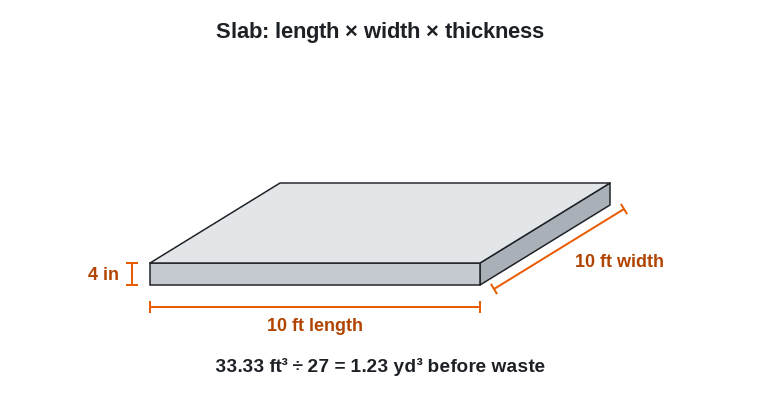
- Convert the thickness: 4 in ÷ 12 = 0.333 ft.
- Multiply: 10 ft × 10 ft × 0.333 ft = 33.33 ft³.
- Convert to yards: 33.33 ÷ 27 = 1.23 yd³ of concrete.
- Add 10% waste: 1.23 × 1.10 = 1.36 yd³. In practice, order 1.5 yd³, because plants sell in quarter-yard steps and short loads carry fees.
- In bags, the same slab with waste (36.67 ft³) takes 62 × 80 lb bags. A ready-mix truck is the smarter buy at this size.
Result: 1.23 yd³ exact, 1.36 yd³ with 10% waste, or 62 × 80 lb bags if you mix it yourself.
Concrete Needed for Common Slab Sizes (4 in thick, before waste)
| Slab size | Cubic feet | Cubic yards | 80 lb bags |
|---|---|---|---|
| 8 × 8 ft | 21.33 ft³ | 0.79 yd³ | 36 bags |
| 10 × 10 ft | 33.33 ft³ | 1.23 yd³ | 56 bags |
| 12 × 12 ft | 48.00 ft³ | 1.78 yd³ | 80 bags |
| 10 × 20 ft | 66.67 ft³ | 2.47 yd³ | 112 bags |
| 20 × 20 ft | 133.33 ft³ | 4.94 yd³ | 223 bags |
| 24 × 24 ft | 192.00 ft³ | 7.11 yd³ | 320 bags |
| 20 × 30 ft | 200.00 ft³ | 7.41 yd³ | 334 bags |
Slab Yardage by Thickness: 4, 5 and 6 in
Use this chart when you know the footprint but have not settled the thickness. Figures are exact cubic yards before waste. If you are unsure which column applies, start with how thick a concrete slab should be.
| Slab size | 4 in | 5 in | 6 in |
|---|---|---|---|
| 10 × 10 ft | 1.23 yd³ | 1.54 yd³ | 1.85 yd³ |
| 12 × 12 ft | 1.78 yd³ | 2.22 yd³ | 2.67 yd³ |
| 12 × 20 ft | 2.96 yd³ | 3.70 yd³ | 4.44 yd³ |
| 20 × 20 ft | 4.94 yd³ | 6.17 yd³ | 7.41 yd³ |
| 24 × 24 ft | 7.11 yd³ | 8.89 yd³ | 10.67 yd³ |
| 30 × 30 ft | 11.11 yd³ | 13.89 yd³ | 16.67 yd³ |
| 30 × 40 ft | 14.81 yd³ | 18.52 yd³ | 22.22 yd³ |
How to Measure an L-Shaped or Irregular Slab
Split the outline into rectangles that do not overlap, run each one, and add the results. Take a patio with a 20 × 12 ft main area and an 8 × 10 ft wing. The areas are 240 ft² and 80 ft², so the total is 320 ft². At 4 in thick that is 106.67 ft³, or 3.95 yd³. With 10% waste it comes to 4.35 yd³, so order 4.5 yd³.
For a triangular corner, multiply the two sides that meet at the right angle and halve the result. For a round pad, multiply 3.1416 by the radius squared. Use the area of the finished shape, not the rectangle around it: a 12 ft circle covers 113.1 ft², while its 12 × 12 ft box covers 144 ft², which would over-order by 27%.
Slabs With a Thickened Edge
A monolithic slab has a deeper strip around its edge that acts as the footing, and a flat calculation misses it. Work out the flat slab first. Then add perimeter × edge width × the extra depth below the slab.
For a 24 × 24 ft garage slab, 4 in thick, with an edge 12 in wide and 12 in deep in total, the extra depth is 8 in. The flat part is 7.11 yd³. The edge adds 96 ft × 1 ft × 0.667 ft = 64 ft³, or 2.37 yd³. The total is 9.48 yd³, a third more than the flat slab alone. Counting the full outside perimeter slightly overstates the corners, which is the safe direction to be wrong.
Why an Uneven Base Uses More Concrete Than You Expect
Base depth errors hit thin slabs hardest. If the base under a 20 × 20 ft slab sits just half an inch low on average, it takes another 16.67 ft³, or 0.62 yd³. On a 4 in slab that is 12.5% more concrete, which uses up a 10% waste allowance before anything spills.
Check before you order. Pull a string across the forms and measure down to the base in at least nine spots, then use the average as your thickness. Coming up half a yard short in the middle of a pour can cost you a second delivery and a cold joint.
Before You Order: Slab Checklist
Confirm these points before you give the plant a number.
- Thickness is the average measured depth, not the height of the form board.
- Thickened edges, steps and pads for posts are added separately.
- The total is rounded up to the next quarter yard after waste.
- Control joint layout is marked, commonly every 10 to 12 ft on residential slabs and closer on thin or narrow ones.
- Steel is bought and on chairs, so it ends up inside the slab instead of on the ground. Count it with the rebar calculator.
- The truck can reach the forms. A loaded mixer is far heavier than a car and can damage a driveway.
Frequently Asked Questions
How much concrete do I need for a 10×10 slab?
At 4 in thick, a 10×10 ft slab needs 33.33 ft³, which is 1.23 cubic yards. At 6 in thick it rises to 1.85 yd³. Add 5 to 10% for waste, so plan on ordering 1.5 yd³ for the 4 in slab.
How much concrete do I need for a 20×30 slab?
At 4 in thick, a 20×30 ft slab is 200 ft³, which is 7.41 cubic yards. With a 10% waste allowance, order 8.25 yd³. The pour would take 334 × 80 lb bags before waste, well past the ready-mix crossover.
How thick should a concrete slab be?
Four inches is standard for patios, walkways, shed floors and most residential flatwork. Use 5 to 6 in for driveways, RV pads, and garage floors that carry vehicles. Use 6 in or more with reinforcement for heavy trucks or shop equipment.
How many bags of concrete for a slab instead of ready-mix?
Divide the slab's cubic feet by the bag yield: 0.60 ft³ (80 lb), 0.45 (60 lb), 0.375 (50 lb), or 0.30 (40 lb). A 10×10 slab at 4 in takes 56 × 80 lb bags before waste. Above about one cubic yard, a ready-mix truck is cheaper and far less work.
Does rebar or mesh change how much concrete I need?
No. Reinforcement sits inside the slab and displaces a negligible amount of concrete, so the volume stays the same. It changes strength and crack control, not yardage, so estimate the steel separately.
Why does the calculator add a waste percentage?
Subgrade is never perfectly flat, forms bow slightly, and concrete is lost to spillage and what coats the chute and tools. Five to ten percent covers a clean, well-formed pour; rough or hand-dug work can need 15%. Running short mid-pour is far more expensive than a small over-order.
Related Calculators
Helpful Guides
Concrete Bags
How Many Bags of Concrete for a 10x10 Slab? (+ Common Slab Sizes)
How many bags of concrete for a 10x10 slab? A 4 inch slab needs 56 bags of 80 lb mix, or 62 with waste. See the size chart and thickness math.
Read guideSlab & Flatwork
How to Calculate Concrete for a Slab
Calculate concrete for any slab: convert thickness to feet, multiply, divide by 27, add waste. Worked example, size chart and the subgrade mistake to avoid.
Read guideSlab & Flatwork
How Thick Should a Concrete Slab Be? (4 in vs 6 in)
Four inches for patios, 5 to 6 for driveways and garages, but base quality beats extra thickness. Thickness table, the 2x4 trap and what extra costs.
Read guide