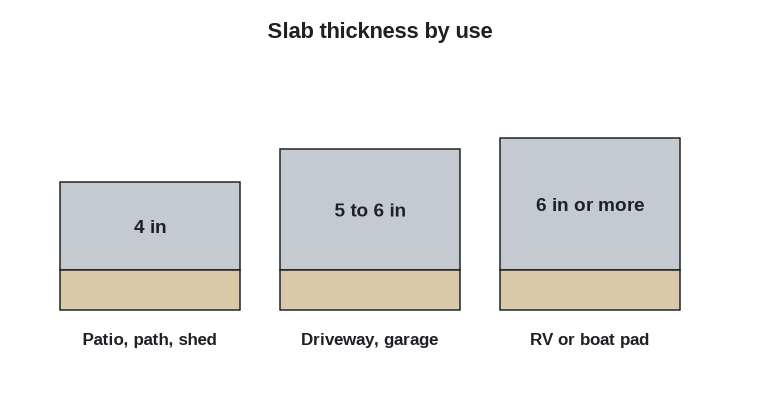
Four inches suits walkways, patios, and most shed pads. Driveways and garage floors that carry vehicles need 5 to 6 in. An RV or boat pad needs 6 in or more.
Base quality matters as much as the number. A 4 in slab on a proper compacted gravel base outlasts a 6 in slab poured on mud. Thickness is one dial, not the whole machine.
Test the volume effect of any thickness in the concrete slab calculator.
The thickness table by use #
| Use | Recommended thickness | Notes |
|---|---|---|
| Walkways and patios | 4 in | Foot traffic and furniture only |
| Shed pads | 4 in | Go to 6 in under heavy equipment or a hot tub |
| Driveways | 5 to 6 in | 4 in is a minimum for cars only, and only on an excellent base |
| Garage floors | 5 to 6 in | Vehicles, storage loads, and point loads from equipment |
| RV and boat pads | 6 in or more | Sustained heavy loads, parked in one spot for months |
Read the table by load, not by project name. A patio that will carry a hot tub belongs in the heavier line.
A driveway used only by a small car on an excellent base can live at the minimum. The same driveway on soft ground belongs at the top of its range.
Every figure assumes the base work described later. Local code and frost rules may also set minimums where a slab meets a building or street.
The 2x4 trap: your 4 in slab that is actually 3.5 in #
The most common thickness mistake in residential work is not a decision. It is lumber. A standard 2x4 is 3.5 in tall, not 4 in.
Forms built from 2x4s produce a 3.5 in slab when the top of the board marks the top of the slab. Owners design 4 in, order for 4 in, and pour 3.5 in. The slab ends up thinner than intended, with extra concrete left over.
Half an inch sounds trivial until you think in proportions. Dropping from 4 in to 3.5 in removes one eighth of the thickness. Bending capacity falls faster than thickness, as the next sections explain.
For a walkway, 3.5 in may serve fine for decades. For a driveway that was supposed to sit at its 4 in minimum for cars, the trap quietly puts you below the minimum you chose.
Pros handle this in two honest ways. They design for 3.5 in where that thickness is genuinely adequate and order accordingly. Or they use deeper forms, such as 2x6 lumber for a 4 to 5 in slab.
Crews set, stake, and measure those forms to the exact intended top of slab. Do not assume the lumber's name is its dimension. It never has been.
The fix at planning time is free. Decide the thickness and choose form lumber that can deliver it. Verify with a tape at several points after the forms are staked, before the truck is called.
Measure from the compacted base to the top of the form, not from whatever lump of soil is nearby. Low spots in the base steal thickness just as surely as short forms do.
What extra thickness costs #
Thickness is bought by the cubic yard, so its price is easy to calculate. Take a 20 x 20 ft slab.
At 4 in thick, volume is 400 ft2 x 0.333 ft = 133.3 ft3, which is 4.94 yd3. At 6 in thick, volume is 400 x 0.5 = 200 ft3, which is 7.41 yd3.
The difference is 2.47 yd3. At $170 per yd3, stepping from 4 in to 6 in on this slab costs about $420 more in concrete alone.
That is real money, and it is not the whole story. The extra depth usually costs nothing extra in forming or finishing, because the surface area is identical. It buys load capacity and crack tolerance for the life of the slab.
Spend it where loads justify it: driveways, garages, RV pads, and any slab whose use might grow heavier. A patio poured at 4 in today sometimes becomes the pad for a heavy spa or outdoor kitchen later. Retrofitting thickness is impossible, because you would be replacing the slab.
Where use is certain and light, 4 in done properly beats 6 in done carelessly. The saving is better spent on base material and compaction.
Run your own area through the concrete slab calculator at both thicknesses before deciding.
Thickness is not strength: PSI is a different dial #
Owners often ask for a thicker slab when what they are worried about is strength, and the two are not the same. Thickness is geometry. PSI is the compressive strength of the mix itself.
They are separate dials, and turning one does not turn the other.
A 4 in slab of 4,000 PSI concrete outperforms a 6 in slab of 2,500 PSI concrete for surface wear. The stronger surface resists abrasion, scaling, and tire wear better.
But bending capacity grows with thickness, and it grows fast, roughly with thickness squared. A thicker section resists flexing and cracking under a concentrated load far better, regardless of mix.
Put plainly, thickness is about load spreading. It distributes a wheel or post load over a wider area of base, so neither the concrete nor the soil beneath takes too much stress.
Match the dial to the problem. Worried about a surface that dusts, wears, or flakes? That is mix, curing, and finishing.
Worried about cracking under a heavy vehicle on imperfect ground? That is thickness, base, and reinforcement working together. Most good residential slabs set both dials sensibly rather than cranking one to compensate for the other.
See how much concrete you need for how mix and volume decisions fit together when ordering.
Base quality and edge thickening: where slabs actually succeed #
A slab is only as good as what is under it. Four inches of concrete on 4 to 6 in of compacted gravel will outlast 6 in of concrete on mud. The gravel base spreads loads evenly so the slab is supported everywhere.
The base also drains water away instead of letting it soften the support. And it stays put instead of shrinking, swelling, and settling unevenly as seasons change.
Uneven support is the true enemy. A slab bridges a small soft spot until it cannot, then it cracks.
Compaction is what makes support uniform. Crews place the base in lifts, compact it, and check it. It is dull work that no one photographs.
It is also the difference between a slab that ages quietly and one that settles at a corner within two winters. If budget forces a choice between an extra 2 in of concrete and a proper base under standard thickness, choose the base.
Edges need their own attention. A thickened edge, or turn-down edge, is a deeper section of concrete around the perimeter. It acts like a shallow grade beam cast as part of the slab.
In frost country it gets the edge down toward frost depth, so heaving soil does not lift and crack the perimeter. Under load points near an edge, it puts extra depth where slabs are weakest. Think of a wheel turning off a driveway, or a post at a corner.
An edge has support on only one side.
Not every slab needs a turn-down edge; interior floors and slabs in mild climates often do without. But ask the question during design for any slab whose edge will carry load or face frost, not after the first cracked corner.
Decide in order: use sets thickness, base makes it honest, forms deliver it, and the mix supplies surface strength.