Concrete Yards Calculator
Ready-mix concrete is ordered by the cubic yard, but job-site measurements come in feet and inches. This concrete volume calculator bridges the two. It also works as a concrete yardage calculator in ready-mix terms.
Free · Instant results as you type · No sign-up
Live preview
Your estimate
Updates as you typeIncludes a 10% waste allowance on top of the exact geometric volume (2.47 yd³). Bag counts are rounded up, because you cannot buy part of a bag.
Enter a pour's length, width, and thickness to get the exact cubic yards. The result also shows cubic feet and cubic meters, the bag equivalent, and the total weight for haul planning.
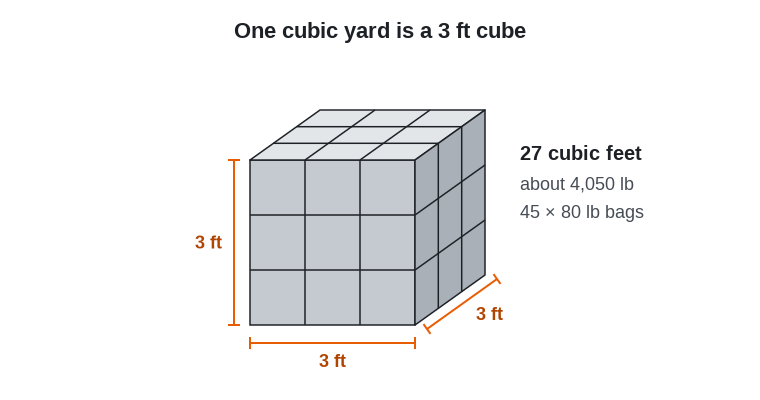
One cubic yard is 27 cubic feet. Picture a cube 3 ft on each side, weighing about 4,050 lb wet.
Most residential pours land between 1 and 10 yards. A 10×10 patio is 1.23 yards, a single-car driveway about 5, and a full ready-mix truck carries 8 to 10 yards per load. A concrete cubic yard calculator states every result in the exact unit the plant will quote you.
How This Calculator Works
Working out how to calculate yards of concrete takes three steps. First, convert thickness from inches to feet by dividing by 12. Second, multiply length × width × thickness to get cubic feet.
Third, divide by 27 to get cubic yards. Every yardage error traces back to one of these steps. Most often, someone multiplies by a thickness that no one converted.
Once you calculate concrete yardage exactly, order more than the exact figure. Plants batch in quarter-yard increments and charge short-load fees for small orders. Forms, subgrade variation, and spillage also consume real concrete.
The 5 to 10% waste allowance in this calculator brings the exact geometry up to a realistic order quantity. Round up to the plant's increment from there.
The unit selectors accept meters, centimeters, and millimeters on every field if your dimensions are metric. They mix freely with imperial fields. A slab measured as 4 m × 3 m × 100 mm is 1.2 m³, which the calculator also reports as about 1.57 yd³.
Formula: Cubic yards = (Length ft × Width ft × Thickness in ÷ 12) ÷ 27 · 1 yd³ = 27 ft³ = 0.765 m³
Worked Example: Yardage for a 20 × 10 ft driveway slab, 4 in thick
- Thickness in feet: 4 ÷ 12 = 0.333 ft.
- Cubic feet: 20 × 10 × 0.333 = 66.67 ft³.
- Cubic yards: 66.67 ÷ 27 = 2.47 yd³ exact.
- With 10% waste: 2.47 × 1.10 = 2.72 yd³. Order 2.75 yd³.
- Weight check: 2.47 yd³ × 4,050 lb ≈ 10,000 lb of wet concrete.
Result: 2.47 cubic yards exact; order 2.75 yd³ with a normal waste allowance.
What One Cubic Yard Covers at Common Thicknesses
| Thickness | Coverage per yd³ | Coverage per 80 lb bag |
|---|---|---|
| 2 in | 162 ft² | 3.60 ft² |
| 3 in | 108 ft² | 2.40 ft² |
| 4 in | 81 ft² | 1.80 ft² |
| 5 in | 64.8 ft² | 1.44 ft² |
| 6 in | 54 ft² | 1.20 ft² |
| 8 in | 40.5 ft² | 0.90 ft² |
Cubic Yards for Typical Projects
Each order quantity below adds 10% waste and rounds up to the next quarter yard. Post hole figures ignore the space the posts take up.
| Project | Exact volume | Order quantity |
|---|---|---|
| 12 × 20 ft patio, 4 in | 2.96 yd³ | 3.50 yd³ |
| 10 × 40 ft driveway, 4 in | 4.94 yd³ | 5.50 yd³ |
| 24 × 24 ft garage, 6 in | 10.67 yd³ | 11.75 yd³ |
| 20 × 40 ft driveway, 5 in | 12.35 yd³ | 13.75 yd³ |
| 40 ft of 16 × 8 in footing | 1.32 yd³ | 1.50 yd³ |
| 8 post holes, 12 in × 3 ft | 0.70 yd³ | 1.00 yd³ |
How Far a Given Number of Yards Will Go
Work backward when you have a fixed amount: a minimum order, part of a load, or a full truck. Square feet covered = cubic yards × 324 ÷ thickness in inches. Take 10% off for waste to get a safe plan area.
| Cubic yards | 4 in thick | 5 in thick | 6 in thick |
|---|---|---|---|
| 1 yd³ | 81 ft² | 64.8 ft² | 54 ft² |
| 3 yd³ | 243 ft² | 194.4 ft² | 162 ft² |
| 5 yd³ | 405 ft² | 324 ft² | 270 ft² |
| 8 yd³ | 648 ft² | 518.4 ft² | 432 ft² |
| 10 yd³ | 810 ft² | 648 ft² | 540 ft² |
Yardage Formulas for Other Shapes
The calculator above handles rectangular pours. For anything else, find cubic feet with the right formula, then divide by 27. Keep every dimension in feet.
| Shape | Cubic feet | Dedicated tool |
|---|---|---|
| Round pad or pier | 3.1416 × radius² × depth | sonotube calculator |
| Wall | length × height × thickness, minus openings | wall calculator |
| Solid steps | width × tread × rise × n(n + 1) ÷ 2 | steps calculator |
| Strip footing | run length × width × depth | footing calculator |
| Triangle slab | base × height ÷ 2 × thickness | Use the formula, then divide by 27 |
Measure Depth, Do Not Assume It
Length and width are easy to measure well. Depth is where yardage goes wrong. Suppose a 20 × 10 ft slab is planned at 4 in, but five checks inside the forms read 4, 4.5, 4.25, 5 and 4.25 in. The average is 4.4 in, so the pour is 73.33 ft³, or 2.72 yd³, not 2.47. That is 10% more concrete before any spillage.
Do not confuse square yards with cubic yards either. Square yards measure area, so they say nothing about depth. A 20 × 10 ft slab is 22.2 square yards at any thickness, while its cubic yards change with every inch.
What to Tell the Ready-Mix Plant
Have these details ready and the plant can quote and schedule in one call. For the full comparison with bagged mix, see bags or ready-mix.
- Cubic yards after waste, rounded up to the plant's increment.
- Strength in PSI, and air entrainment if the concrete will face freezing weather.
- Slump, or simply what you are pouring so the dispatcher can suggest one.
- How the concrete leaves the truck: chute, wheelbarrow, or pump.
- The minimum order, short-load fee, and how many minutes of unloading time are included.
Frequently Asked Questions
How do I calculate cubic yards of concrete?
Multiply length × width × thickness with all dimensions in feet (thickness in inches divided by 12), then divide the cubic feet by 27. A 10×10 ft slab at 4 in is 33.33 ft³, which is 1.23 yd³.
How many cubic feet are in a yard of concrete?
Twenty-seven. A cubic yard is a 3 ft cube on each side, and it weighs roughly 4,050 lb, just over 2 tons, at standard density.
How many yards of concrete come on a truck?
A standard ready-mix truck carries 8 to 10 cubic yards per load. Orders below a plant's minimum, often 1 to 1.5 yd³, usually attract a short-load fee. Ask about the fee before you finalize quantities.
How many yards of concrete per truck?
Eight to ten cubic yards per load is standard. Larger pours split across trucks that the plant schedules back to back. The full quantity then arrives while the first loads are still workable, so tell the plant the total yardage.
Should I round my yardage up or down?
Always up, to the plant's batching increment (usually a quarter yard). A second partial delivery costs far more than the extra quarter yard, and a short pour leaves a cold joint that never bonds properly.
How do I convert cubic yards to cubic meters?
Multiply cubic yards by 0.765. One cubic yard is 0.7646 m³, and one cubic meter is about 1.308 yd³. This calculator shows both units for every result.
Related Calculators
Helpful Guides
How-To Guides
Bags vs Ready-Mix: Yards Per Truck & When to Order a Truck
A mixer truck carries 8 to 10 yards, but the real question is your size. Costed comparison at half, one, two and five yards, plus the 90-minute rule.
Read guideHow-To Guides
Concrete Volume Conversions: Yards, Feet & Meters
Convert concrete volumes fast: 1 cubic yard = 27 cubic feet = 0.765 cubic meters. Conversion table, coverage per yard and the three errors that wreck orders.
Read guide