Tons to Cubic Yards Converter
Aggregate suppliers sell gravel, crushed stone, and sand by the ton. Your driveway, base course, and landscape plans all use cubic yards. This tons to yards calculator bridges the two units.
Free · Instant results as you type · No sign-up
Your estimate
Updates as you typeLoose-material densities vary with moisture and compaction. When a supplier weighs loads, order by the ton and use this as a coverage check.
Pick the material and enter the amount. The calculator converts tons to cubic yards or cubic yards to tons at that material's real density. Gravel and crushed stone run 1.40 tons per cubic yard, but topsoil runs only 1.10.
Picking the right material matters more than the arithmetic.
No universal tons-to-yards number exists, and any chart that gives one without naming a material is guessing. A ton measures weight, 2,000 lb in the US. A cubic yard measures volume, 27 ft³, and density alone bridges them.
Density changes with rock type, particle size, pile looseness, and moisture. This page makes the density explicit, so you see exactly which assumption your conversion uses. Every cubic yards to tons gravel conversion here names its material and its density.
How This Calculator Works
Once you fix the density, the math takes one division or one multiplication. Cubic yards equal tons divided by tons per cubic yard. Tons equal cubic yards times tons per cubic yard.
For gravel at 1.40 tons per yd³, 10 tons ÷ 1.40 = 7.14 yd³. In reverse, 5 yd³ × 1.40 = 7.0 tons. The selector uses loose, delivered densities, meaning material as it sits in the truck and the pile.
Loose material is not compacted in place. Gravel compacted into a driveway base packs tighter, so a delivered yard covers slightly less area than the loose math suggests. Order 5 to 10% extra to cover compaction and grading losses.
Moisture is the biggest swing factor. Dry sand sits near 1.35 tons per yd³. Gravel delivered after rain can run 10 to 15% heavier, because water fills the voids between stones.
You pay for that water weight by the ton, and the pile covers less than the dry calculation says. Particle shape matters too. Rounded pea gravel settles and packs differently from angular crushed stone.
Broken concrete rubble runs light at about 1.20 tons per yd³, thanks to its air gaps and odd shapes. Solid concrete is far denser.
Keep the two trades straight. Quarries and landscape yards weigh bulk aggregates and sell them by the ton. Bulk aggregates include gravel, stone, sand, topsoil, and crushed concrete.
Plants batch ready-mix concrete and sell it by the cubic yard. Solid cured concrete weighs 2.03 tons per yd³, or 4,050 lb. A yard of concrete and a yard of gravel therefore differ by more than half a ton.
For delivery planning, a standard single-axle dump truck hauls about 10 to 14 tons per load. That equals roughly 7 to 10 yd³ of gravel, so a 20-ton order usually takes two truck trips. The delivery fee follows the trips, not the tonnage.
Formula: Cubic yards = Tons ÷ Tons per yd³ · Tons = Cubic yards × Tons per yd³ · Gravel density = 1.40 tons per yd³
Worked Example: 10 tons of gravel, converted and put to work
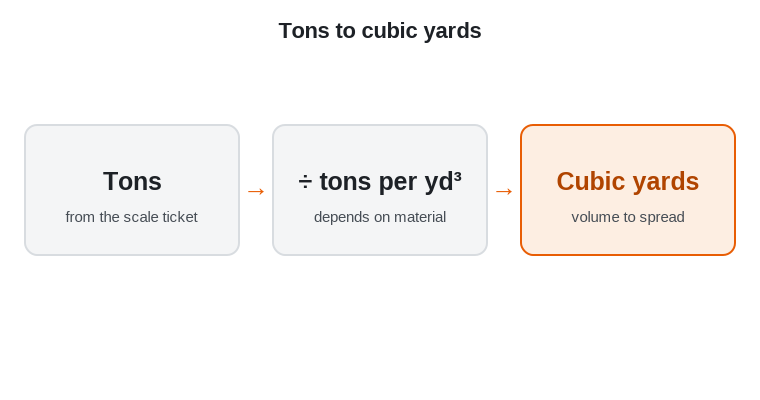
- Divide by the gravel density: 10 tons ÷ 1.40 tons per yd³ = 7.14 yd³.
- Coverage check: 7.14 yd³ × 108 ft² per yard = about 771 ft² at 3 in deep. That area matches a parking pad roughly 21 × 36 ft.
- Reverse check: 5 yd³ of crushed concrete at 1.35 tons per yd³ weighs 5 × 1.35 = 6.75 tons, the number hauling quotes use.
Result: 10 tons of gravel = 7.14 yd³, covering about 771 ft² at 3 in deep. In reverse, 5 yd³ of crushed concrete = 6.75 tons.
Tons per Cubic Yard by Material (loose, delivered)
| Material | Tons per yd³ | Cubic yards per ton |
|---|---|---|
| Gravel / crushed stone | 1.40 | 0.71 yd³ |
| Pea gravel | 1.35 | 0.74 yd³ |
| Crushed concrete | 1.35 | 0.74 yd³ |
| Sand (dry) | 1.35 | 0.74 yd³ |
| Broken concrete / rubble | 1.20 | 0.83 yd³ |
| Topsoil | 1.10 | 0.91 yd³ |
| Solid concrete (for contrast) | 2.03 | 0.49 yd³ |
Frequently Asked Questions
How many cubic yards are in a ton of gravel?
At the standard gravel density of 1.40 tons per cubic yard, one ton of gravel equals 1 ÷ 1.40, or 0.71 yd³. That ton covers about 77 ft² at 3 in deep and 115 ft² at 2 in deep, but wet gravel covers slightly less. How many yards in a ton of gravel means 0.71 yd³, and how many tons in a yard of gravel means 1.40 tons.
How many yards is 5 tons of gravel?
5 ÷ 1.40 = 3.57 yd³ of gravel. That covers about 386 ft² at 3 in deep, roughly a 12 × 32 ft parking area or a short driveway top-up. Run it backward and 5 yd³ of gravel weighs 7 tons, the figure a hauling or disposal quote uses.
How many tons are in 10 cubic yards of gravel?
10 yd³ × 1.40 tons per yd³ = 14 tons of gravel. That exceeds one standard dump truck load of 10 to 14 tons per trip. Expect the supplier to split it into two deliveries or send a larger tri-axle truck, and confirm whether you pay one delivery fee or two.
Why did my delivered gravel look like less than I ordered?
Usually density and compaction explain it, not short weight, because the quarry scale ticket is certified. Wetter material adds water weight, loose yards compact down 5 to 10% once spread and driven on, and heaped loads settle in transit. Weigh the conversion both ways with this tool before you dispute a load, and check the ticket tonnage against your order.
Is a ton the same as a tonne?
No, this converter uses the US short ton of 2,000 lb, the unit US quarries and landscape yards sell by. A metric tonne is 1,000 kg, about 2,205 lb, and roughly 10% heavier than a US ton. If a supplier quotes in tonnes, multiply your US ton figure by 0.907 to get tonnes.
How many tons does a dump truck hold?
A standard single-axle dump truck hauls about 10 to 14 tons per load, roughly 7 to 10 yd³ of gravel at 1.40 tons per yd³. Larger tri-axle trucks carry 16 to 22 tons. Small landscape trucks and dump trailers often hold only 3 to 5 tons, so a 14-ton order means three or four trips.