Gravel Calculator
This gravel calculator converts length, width and depth into cubic yards and tons using material density. Most yards sell gravel by weight, so the tonnage result matches the scale ticket. As a gravel yard calculator, it also states loose cubic yards alone, so you can check a quote given in yards.
Free · Instant results as you type · No sign-up
Live preview
Your estimate
Updates as you typeIncludes a 10% waste allowance on top of the exact geometric volume (1.85 yd³). Bag counts are rounded up, because you cannot buy part of a bag.
Depth causes most ordering mistakes because buyers under-measure it. Three inches of loose gravel compacts to roughly two and a half inches after driving or walking on it. Enter the finished depth you want and keep the waste allowance on for uneven ground.
How This Calculator Works
The calculator finds volume like any slab: length × width × depth, with depth converted from inches to feet. A 20 × 10 ft area at 3 in deep equals 200 ft² × 0.25 ft, or 50 ft³. Dividing 50 by 27 gives 1.85 yd³, the loose volume needed to fill the space.
Density converts volume to weight. Standard gravel and crushed stone run about 1.40 tons per cubic yard. Pea gravel, river rock and dry sand sit closer to 1.35 tons per yard.
Multiply 1.85 yd³ by 1.40 to get 2.59 tons for the example above. The yard will load and charge you for that tonnage.
Match depth to the job: 4 to 6 in for a driveway base and 3 in for walkways and landscape beds. Use about 4 in under patio pavers. For drainage, use 3/4 in washed stone with no fines so water moves through it.
Lay landscape fabric under decorative gravel and walkways to stop stone migrating into the soil. Expect loose material to settle roughly 10% or more after compaction and rain. The waste allowance covers that shrinkage.
Used as a gravel road calculator, the same area math applies because a lane is a long, narrow rectangle. Build its 6 to 9 in of stone in two compacted lifts instead of one loose layer.
Formula: Volume = Length × Width × Depth (all in feet) · Cubic yards = Cubic feet ÷ 27 · Tons = Cubic yards × density (tons per yd³)
Worked Example: A 20 × 10 ft area, 3 in deep
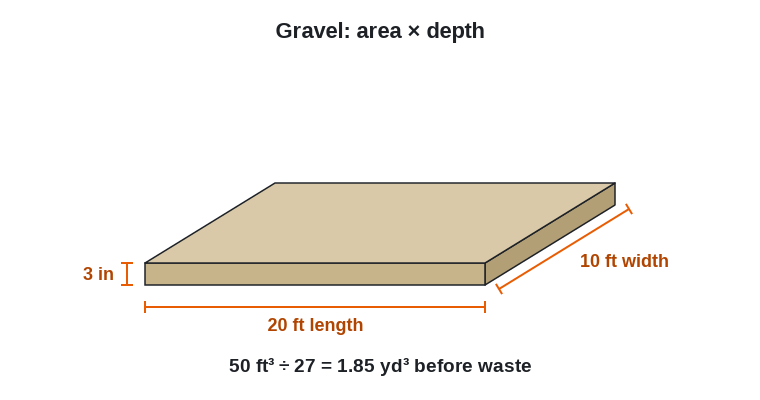
- Convert the depth: 3 in ÷ 12 = 0.25 ft.
- Multiply: 20 ft × 10 ft × 0.25 ft = 50 ft³.
- Convert to yards: 50 ÷ 27 = 1.85 yd³.
- Convert to tons at 1.40 tons per yd³: 1.85 × 1.40 = 2.59 tons exact.
- Add 10% waste: 2.04 yd³ and 2.85 tons. Order 3 tons so compaction and uneven ground do not leave you short.
Result: Exact total: 1.85 yd³ (2.59 tons). With 10% waste: 2.04 yd³ (2.85 tons), so order 3 tons. One ton of gravel covers about 77 ft² at 3 in deep.
How Much Gravel per Area at 3 in Deep
| Area | Cubic feet | Cubic yards | Tons (at 1.40 t/yd³) |
|---|---|---|---|
| 100 ft² | 25 ft³ | 0.93 yd³ | 1.30 tons |
| 200 ft² | 50 ft³ | 1.85 yd³ | 2.59 tons |
| 500 ft² | 125 ft³ | 4.63 yd³ | 6.48 tons |
| 1,000 ft² | 250 ft³ | 9.26 yd³ | 12.96 tons |
Frequently Asked Questions
How many tons are in a cubic yard of gravel?
Standard gravel and crushed stone weigh about 1.4 tons per cubic yard. Pea gravel, river rock and dry sand weigh roughly 1.35 tons per yard. Wet material weighs more, so suppliers sell by the scale ticket rather than the scoop.
How much area does one ton of gravel cover?
At 3 in deep, one ton covers about 77 ft². At 2 in deep it covers approximately 115 ft², and at 4 in deep about 58 ft². Coverage drops fast as depth rises, so measure depth honestly before ordering.
Do I need landscape fabric under gravel?
Walkways, beds and decorative areas need fabric under the gravel. Fabric stops gravel sinking into soil and cuts mud working up through the stone. Crews usually skip fabric under a compacted driveway base because base stone should lock into the subgrade.
Crushed stone or pea gravel: which compacts better?
Crushed stone compacts far better because its angular edges and mixed fines lock together. Pea gravel is rounded, so it rolls and shifts underfoot and under tires. Save pea gravel for decorative beds, dog runs and drainage where movement does not matter.
How much gravel goes under a concrete slab?
Most slabs sit on 4 to 6 in of compacted crushed stone. Use 4 in for interior and light-duty slabs, and 6 in for driveways or soft clay soil. For a how much gravel under concrete slab calculator result, enter slab length and width above with depth set to base thickness.
What is the minimum delivery order for gravel?
Most yards deliver from about 1 ton up. Delivery fees of $50 to $100 or more on a small load can cost more than the stone. Below roughly 2 tons, a pickup load or bagged gravel from a home center often costs less than a delivered dump load.