One ton of gravel covers about 77 square feet at 3 inches deep. At the standard density for gravel, 1 ton equals 0.71 cubic yards, or 19.29 cubic feet. Suppliers sell gravel by the ton, while your project dimensions produce a volume.
Use the tons to cubic yards converter for your exact area and depth. Check the result against the tables below before you order.
Tons vs yards explained once #
Tons measure weight. Cubic yards measure volume. Density, expressed as tons per cubic yard, bridges the two.
Gravel weighs about 1.40 tons per cubic yard. Divide tons by 1.40 to get yards, and multiply yards by 1.40 to get tons. So 1 ton / 1.40 = 0.71 cubic yards.
In cubic feet, that equals 0.71 x 27 = 19.29 cubic feet per ton.
Not every aggregate weighs the same per yard. Topsoil weighs less per yard than crushed stone.
The material itself and the air gaps between pieces change the weight. One universal conversion therefore fails when you switch materials.
| Material | Tons per yd3 |
|---|---|
| Crushed stone | 1.40 |
| Pea gravel | 1.35 |
| Crushed concrete | 1.35 |
| Dry sand | 1.35 |
| Rubble | 1.20 |
| Topsoil | 1.10 |
Use your supplier's density figure for a specific product when they quote one. Local stone, moisture content, and gradation all shift weight slightly. The table gives reliable planning figures for the six common materials above.
Coverage tables by depth #
Coverage equals volume spread over an area. Deeper coverage means less area per ton or per yard. Both tables below use gravel at 1.40 tons per cubic yard.
Coverage per ton:
| Depth | Coverage per ton |
|---|---|
| 2 in | 116 ft2 |
| 3 in | 77 ft2 |
| 4 in | 58 ft2 |
| 6 in | 39 ft2 |
Coverage per cubic yard:
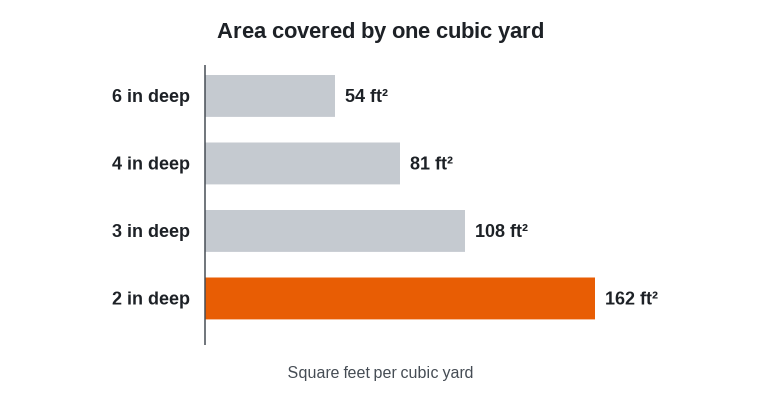
| Depth | Coverage per yd3 |
|---|---|
| 2 in | 162 ft2 |
| 3 in | 108 ft2 |
| 4 in | 81 ft2 |
| 6 in | 54 ft2 |
Divide your area by the coverage figure to use the tables. A 770 square foot area at 3 inches deep needs 770 / 77 = 10 tons.
The same area needs 770 / 108 = about 7.13 cubic yards. Multiply 7.13 yards by 1.40 and you get back to about 10 tons.
The two methods should agree. A mismatch means you mixed up depth or density.
Compaction changes the final depth. Loose gravel compacts about 10% under traffic and tamping. Order for a finished depth of 4 inches after compaction, not 4 inches loose.
Spreading exactly 4 inches loose leaves the finished surface thin. Keep the 10% compaction allowance separate from any waste allowance. Waste covers spillage and uneven ground.
Choosing depth by project #
Each project has a working range. The range balances coverage, stability, and cost.
| Project | Recommended depth |
|---|---|
| Driveway base | 4 to 6 in |
| Driveway top layer | 2 to 3 in |
| Walkway | 3 in |
| Drainage bed | 6+ in of washed 3/4 in |
A driveway needs a thick base. Vehicle weight concentrates on tire paths and turns soft subgrade into ruts.
The base layer uses larger, angular stone that locks together. The top layer runs thinner and uses a size crews can grade and drive on easily.
A walkway at 3 inches handles foot traffic on a prepared base. Extra depth wastes material without adding useful performance.
A drainage bed needs different material. It needs 6 inches or more of washed 3/4 inch stone. Water must move through the voids between stones.
Never substitute dusty, unwashed stone for drainage work. The fines fill the gaps you pay to create.
Measure depth from the prepared surface, not from ungraded soil. A base that undulates by 2 inches creates gravel depths that undulate too. Low spots then make your tonnage estimate wrong.
Ordering: tons, trucks, and bags #
Landscape and aggregate suppliers sell by the ton. Expect minimum order sizes and a delivery charge. Ask about the minimum and the delivery fee before you order.
Also ask whether the truck can place the load where you need it. Some trucks only dump at the curb or driveway entrance.
A standard dump truck carries 10 to 14 tons per load. One delivery usually covers an order close to that range.
Ask about pricing before you split a slightly larger order into two trips. A second delivery fee can cost more than rounding up the first load.
Bagged gravel suits patches, not whole projects. A 0.5 cubic foot bag at about $5 works out to about $270 per ton equivalent. Bulk pricing by the ton costs far less.
Bags make sense for a small repair or a single drainage spot. They also work for topping up a thin area. They do not make sense for a driveway.
Confirm three things before you order. Know your area in square feet and your target depth after compaction. Know the material density too.
Run the numbers through the tons to cubic yards converter and write down both tons and yards. Suppliers think in tons, but your spreader crew and depth checks think in volume. Holding both numbers prevents the most common phone order mistake.
Plan placement before delivery day. Gravel dumped in the wrong spot moves only by wheelbarrow. A ton weighs 2,000 lb no matter how short the trip.
Clear the route and confirm overhead clearance for the dump bed. Protect pavement you do not want marked.
The core numbers hold for most planning. Gravel runs 1.40 tons per yard and 0.71 yards per ton. One ton covers 77 square feet at 3 inches.
Add about 10% extra for compaction. For other material conversions, return to the homepage and pick the calculator that matches your project.