Sonotube Concrete Calculator
A sonotube is a waxed cardboard form tube that shapes wet concrete into a clean round pier. Builders use it as the standard footing for deck posts, fence posts, light poles, and small outbuildings.
Free · Instant results as you type · No sign-up
Live preview
Your estimate
Updates as you typeIncludes a 10% waste allowance on top of the exact geometric volume (0.47 yd³). Bag counts are rounded up, because you cannot buy part of a bag.
This concrete sonotube calculator takes the tube diameter, the depth of the pour, and the number of tubes. It returns concrete per tube and for the whole job in cubic feet, cubic yards, and 80 lb bag counts.
Bag counts matter here because most sonotube work is a handful of piers. That scale puts the job squarely in mix-it-yourself territory.
At its core it is a concrete tube calculator: diameter, depth and count go in, cubic yards and bags come out. Spelled sono tube, the calculator results stay identical. The pier only cares about the diameter printed on the form.
The defaults model the most common deck job in the US: four 12 in tubes poured 4 ft deep. Diameter is where estimates go wrong. Concrete volume grows with the square of the radius.
Stepping from a 10 in tube to a 12 in tube adds 44% more concrete per foot of depth. A 24 in tube holds four times what a 12 in tube holds. Enter the exact tube size printed on the form, not the post size it will carry, and the bag count stays honest.
How This Calculator Works
Each tube is a cylinder, so its volume is π × radius² × depth. For a 12 in tube, the radius is 0.5 ft, giving π × 0.25 × depth, about 0.785 ft³ per foot of depth.
The calculator multiplies the single tube volume by your tube count. It converts to cubic yards by dividing by 27 and works out bags from the 0.60 ft³ wet yield of an 80 lb bag.
The calculator adds waste last. Sonotube pours are small, but a bell-shaped flare dug at the hole bottom and a few inches of over-pour above the tube consume extra.
Dig the hole to the depth your frost line requires. The pier bottom must sit below the frost line, at 12 in in mild climates and 48 in or more in the far north. Dig the hole about 2 in wider than the tube so it drops in cleanly.
Many builders flare or bell the hole bottom, or set the tube on a wider footing pad, so the pier bears on more soil. The cylinder math excludes that flare, so keep the 10% waste default. Set the tube and backfill around it to hold it in place.
Check the tube is plumb and brace it before the pour. A tube that leans while the concrete is wet becomes a leaning pier forever.
Tubes come in 6, 8, 10, 12, 14, 16, 18, 20, 24, 30 and 36 in diameters. Sizes 8, 10 and 12 in cover most residential work. You cut tube lengths to depth with a saw.
The cardboard is a form, not structure. Below grade, it stays in the ground and slowly degrades without affecting the cured concrete. Above grade, most builders peel or cut away the exposed ring after the concrete sets for a clean finish.
Finish the pier top with a post base or anchor bolt set into the wet concrete. That hardware, not the tube, connects your 6×6 post to the pier.
Formula: Volume per tube = π × (Diameter ÷ 2)² × Depth · Total = per-tube volume × number of tubes · Bags = Cubic feet ÷ 0.60 per 80 lb bag
Worked Example: Four 12 in sonotubes, 4 ft deep (deck piers)
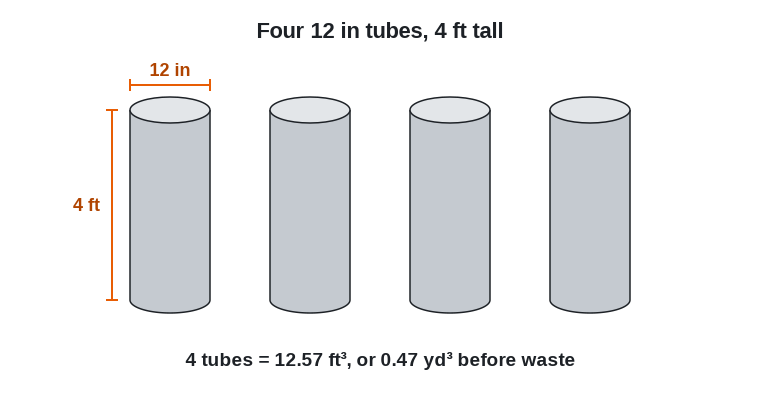
- Radius of a 12 in tube: 12 ÷ 2 = 6 in = 0.5 ft.
- One tube: π × 0.5² × 4 ft = 3.14 ft³, which is 0.12 yd³.
- Four tubes: 3.14 × 4 = 12.57 ft³, or 0.47 yd³ total.
- Bags per tube: 3.14 ÷ 0.60 = 5.2, which rounds up to 6 × 80 lb bags per tube.
- With 10% waste the job total is 13.82 ft³, and 24 × 80 lb bags cover all four piers.
Result: 0.47 yd³ total for four piers (0.12 yd³ per tube), or 6 × 80 lb bags per tube, 24 bags with 10% waste.
Concrete Per Tube, 4 ft Deep (before waste)
| Tube diameter | Cubic feet | Cubic yards | 80 lb bags |
|---|---|---|---|
| 8 in | 1.40 ft³ | 0.05 yd³ | 3 bags |
| 10 in | 2.18 ft³ | 0.08 yd³ | 4 bags |
| 12 in | 3.14 ft³ | 0.12 yd³ | 6 bags |
| 18 in | 7.07 ft³ | 0.26 yd³ | 12 bags |
| 24 in | 12.57 ft³ | 0.47 yd³ | 21 bags |
Frequently Asked Questions
How many bags of concrete for a 12 in sonotube 4 ft deep?
One 12 in tube at 4 ft deep holds π × 0.5² × 4 = 3.14 ft³. At 0.60 ft³ per 80 lb bag that is 5.2 bags, so buy 6 × 80 lb bags per tube. A 60 lb bag yields 0.45 ft³, so the same tube takes 7 of those.
Do you leave the sonotube in the ground?
Yes, below grade: the cardboard tube is only a form, and it stays buried and gradually breaks down without weakening the cured pier. Above grade, most builders peel or cut off the exposed cardboard after the concrete sets, usually 24 to 48 hours, for a clean look. Leaving it does no structural harm.
How deep should a sonotube footing be?
The pier bottom must sit below your local frost line, and local code sets the exact depth. That means roughly 12 in in the mild south, 24 to 36 in mid-country, and 48 in or more in the far north. Deck piers often must reach undisturbed soil, and four feet is the common US default.
What is the difference between a sonotube and a post hole?
A sonotube forms a smooth round pier that ends at or above grade, and the post sits on top in a metal post base. A post hole pour buries the post itself in the concrete, so its volume is a cylinder minus the post. The tube method keeps wood out of the ground, slows rot, and allows post replacement; post holes are faster and cheaper for fences.
What size sonotube do I need for a deck post?
A 10 to 12 in tube is typical for a 6×6 deck post, and 4×4 posts often sit on 8 to 10 in piers. The real answer comes from the load: tributary area, deck height and soil bearing capacity, checked against your local code's span and footing tables. When in doubt, go one size up for a wider margin on weak soil; it costs only about 2 extra bags.