Post Hole Concrete Calculator
This post hole concrete calculator works out the bags you need per hole and for a whole run of fence, deck, or mailbox posts. Unlike a simple cylinder calculation, it subtracts the volume the post itself occupies. On a standard 4×4 that volume is about 11% of the hole, which adds up to real bags over a long fence line.
Free · Instant results as you type · No sign-up
Live preview
Your estimate
Updates as you typeExact geometric volume with no waste allowance. Bag counts are rounded up, because you cannot buy part of a bag.
That deduction makes this the right concrete calculator for post holes rather than a plain cylinder tool.
Enter the hole diameter and depth you actually dug, not the size on the auger box. Hand-dug and augered holes flare at the top and run wider than nominal. The post may carry a fence panel, a deck beam, or a mailbox.
The calculator reports 80 lb and 60 lb bag counts so you can buy whichever your store stocks and your back prefers. This concrete post calculator sizes every pour the same way: hole volume minus post volume.
How This Calculator Works
Each hole is a cylinder: π × radius² × depth. A 12 in diameter hole 3 ft deep holds π × 0.5² × 3 = 2.36 ft³. The post displaces its cross-section times the buried depth, 0.26 ft³ for a 4×4, leaving 2.10 ft³ of concrete per hole.
Bag counts divide that net volume by each bag's yield: 0.60 ft³ for 80 lb and 0.45 ft³ for 60 lb. A concrete post hole calculator that skipped the post deduction would overstate every hole by that 0.26 ft³, nearly half a bag, every time.
Size the hole by two rules. Diameter runs about three times the post width, so a 4×4 takes a 12 in hole. Depth runs between one-third and one-half of the above-ground post height.
Always extend the hole below your local frost line so frost heave cannot jack the post up. In soft soil, bell out the hole bottom wider than the top for extra resistance to uplift and leaning.
Set the post on a 3 to 4 in gravel drainage pad at the hole bottom. That pad does not count in the concrete volume, and it keeps the post end out of standing water.
Fast-setting mixes set in 20 to 40 minutes. You can pour them dry and water them, or pre-mix them for a stronger, more uniform set. Brace the post plumb, and crown the concrete slightly above grade so rain sheds away from the post instead of pooling around it.
Formula: Per hole = π × (diameter ÷ 2)² × depth − post cross-section × depth · Bags = Total net ft³ ÷ yield per bag (0.60 ft³ for 80 lb)
Worked Example: Ten fence post holes, 12 in diameter, 36 in deep, 4×4 posts
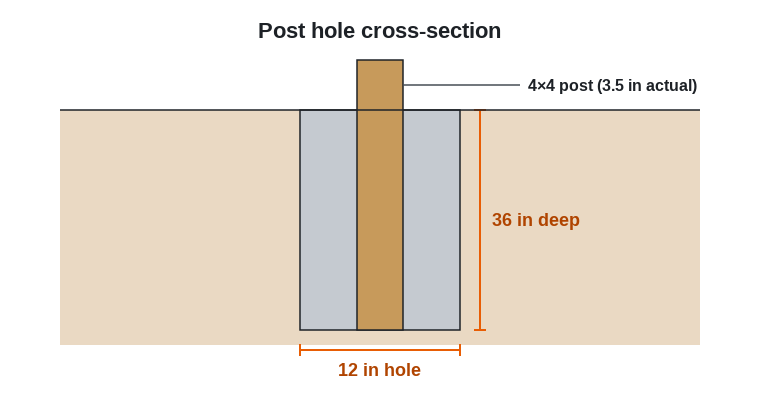
- One empty hole: π × 0.5² × 3 ft = 2.36 ft³.
- Subtract the post: a 4×4 (3.5 in actual) displaces 0.26 ft³ over the 3 ft buried depth.
- Net concrete per hole: 2.36 − 0.26 = 2.10 ft³.
- Ten holes: 2.10 × 10 = 21.01 ft³ total.
- Convert to bags: 21.01 ÷ 0.60 = 36 × 80 lb bags, or 47 × 60 lb bags. That works out to about 4 × 80 lb bags per hole.
Result: 21.01 ft³ total, 36 × 80 lb bags (or 47 × 60 lb bags), roughly 4 × 80 lb bags per post hole.
Per Hole, 3 ft Deep, No Post Deducted (80 lb bags)
| Hole diameter | Cubic feet | 80 lb bags |
|---|---|---|
| 8 in | 1.05 ft³ | 2 bags |
| 10 in | 1.64 ft³ | 3 bags |
| 12 in | 2.36 ft³ | 4 bags |
| 16 in | 4.19 ft³ | 7 bags |
| 18 in | 5.30 ft³ | 9 bags |
Frequently Asked Questions
How many bags of concrete do I need per post hole?
A 12 in diameter, 3 ft deep hole with a 4×4 post needs about 4 × 80 lb bags (2.10 ft³ net). An 8 in hole of the same depth takes 2 bags, and a 16 in hole takes 7 bags before deducting the post.
How deep should post holes be for a 6 ft fence?
Bury one-third to one-half of the above-ground post. That means 24 to 36 in for a 6 ft fence, always below the frost line in cold climates. Shallow, loose soil and tall or solid-panel fences push you toward the 36 in end of that range.
Is dry-pour fast-setting concrete as good as pre-mixed?
Pre-mixing gives a uniform, full-strength set and is the safer choice for deck and structural posts. Dry-pour fast-set works for fences and mailboxes when you add the stated water per bag and let it cure fully. Never dry-pour a post that carries a building load.
Should I put gravel at the bottom of a post hole?
Yes, 3 to 4 in of gravel under the post drains water away from the end grain, where posts rot first. The calculator does not count that pad as concrete, so dig the hole a few inches deeper than the depth you enter.
What is a good fence post concrete rule of thumb?
Budget roughly 4 × 80 lb bags for a standard 12 in diameter, 3 ft deep hole with a 4×4 post. Estimators base most fence lines on that fence post concrete calculator figure. Scale by hole size using the table: about 2 bags for an 8 in hole, 7 for a 16 in hole, before the post deduction.
What does belling the bottom of a post hole do?
Flaring the bottom wider than the top gives the concrete footing a mushroom shape that resists uplift from frost and wind. It helps most in soft or sandy soil, where a straight-sided hole offers little grip against the post being pulled upward.