Concrete Column Calculator
This calculator finds the concrete volume for one rectangular or square column. Enter the column width, its depth from front to back, and its height. It reports volume per column in cubic feet, cubic yards, and 80 lb bag counts.
Free · Instant results as you type · No sign-up
Live preview
Your estimate
Updates as you typeIncludes a 10% waste allowance on top of the exact geometric volume (0.37 yd³). Bag counts are rounded up, because you cannot buy part of a bag.
The calculator reports one column at a time on purpose. Multiply the per-column result by the number of identical columns before you order.
The defaults use the workhorse residential and light-commercial size. That size is a 12 × 12 in column, 10 ft tall.
Column volume grows fast with cross-section size. Doubling a column from 12 × 12 in to 24 × 24 in quadruples the concrete. Per foot of height, volume rises from 1.00 ft³ to 4.00 ft³.
Enter formed dimensions from your plans. Do not enter the nominal lumber size or the size of the steel it supports.
How This Calculator Works
A rectangular column is a simple box. Multiply width by depth by height, with all dimensions in feet. Divide cubic feet by 27 to get cubic yards.
Bags come from standard yields. An 80 lb bag yields 0.60 ft³, and a 60 lb bag yields 0.45 ft³.
A column has a small footprint and a large height, unlike a slab. So its waste allowance covers different risks. It covers concrete lost at the pump or bucket and leakage at the form base.
It also covers the extra few inches you pour at the top. You strike that extra concrete off level after the pour.
Columns are structural elements, full stop. An engineer sets the size and reinforcement from the load the column carries. Typical construction uses vertical bars tied with horizontal ties.
Builders commonly use #3 bar ties at code-prescribed spacing in residential-size columns. Do not shrink a column or cut its steel because the yardage looks high.
Round columns use cylinder math instead. Use the sonotube calculator for round columns and piers. A sonotube pier usually acts as a footing that carries a post.
A true column is a continuous structural member. It carries beams and floors.
Form pressure peaks at the base because fresh concrete acts as a fluid. Pour in lifts and limit your pour rate on tall columns. Do not fill a 10 ft form from the top in one pass.
Consolidate each lift with a vibrator. Columns are narrow and reinforcement is dense, so honeycombing at the base is the classic defect.
A vibrator left too long in one spot can over-pressure the forms. Use short insertions, close spacing, and a steady rhythm.
Formula: Volume per column = Width × Depth × Height (all in feet) · Cubic yards = Cubic feet ÷ 27 · For several columns, multiply the per-column result by the count
Worked Example: A 12 × 12 in column, 10 ft tall
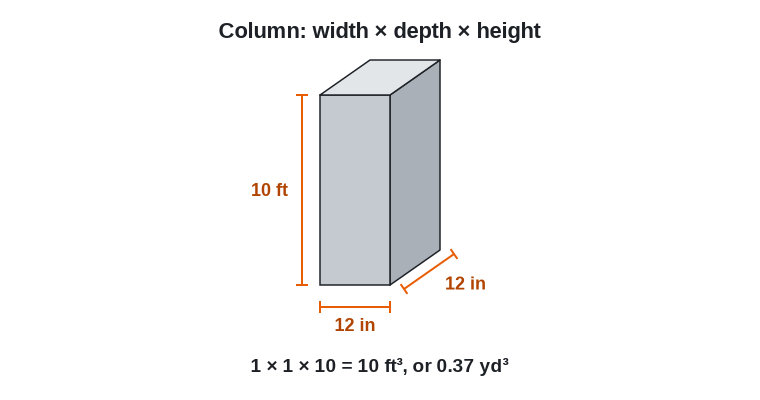
- Convert the cross-section: 12 in = 1 ft, so the column is 1 ft × 1 ft.
- Multiply: 1 ft × 1 ft × 10 ft = 10.00 ft³ per column.
- Convert to yards: 10.00 ÷ 27 = 0.37 yd³ per column.
- In bags: 10.00 ÷ 0.60 = 17 × 80 lb bags per column, before waste.
- A row of four identical columns: 4 × 10.00 = 40.00 ft³ = 1.48 yd³ total.
Result: 0.37 yd³ per column (17 × 80 lb bags before waste); four matching columns take 1.48 yd³ in total.
Concrete Per Column, 10 ft Tall: Square Columns (before waste)
| Column size | Cubic feet | Cubic yards | 80 lb bags |
|---|---|---|---|
| 8 × 8 in | 4.44 ft³ | 0.16 yd³ | 8 bags |
| 10 × 10 in | 6.94 ft³ | 0.26 yd³ | 12 bags |
| 12 × 12 in | 10.00 ft³ | 0.37 yd³ | 17 bags |
| 16 × 16 in | 17.78 ft³ | 0.66 yd³ | 30 bags |
| 24 × 24 in | 40.00 ft³ | 1.48 yd³ | 67 bags |
Frequently Asked Questions
How much concrete for a 12 × 12 column 10 ft tall?
A 12 × 12 in column is 1 ft × 1 ft in cross-section, so 10 ft of height holds 10.00 ft³. That volume equals 0.37 cubic yards, or 17 × 80 lb bags before waste. With the default 10% waste, plan on 0.41 yd³ per column.
How do I calculate a round column?
Use the sonotube calculator, this site's cylinder concrete calculator, for round columns. Its volume, π × radius² × height, runs about 21% below a same-size square column. A 12 in round column, 10 ft tall, holds 7.85 ft³, or 0.29 yd³.
Can I use this as a concrete pier calculator?
Yes, for square or rectangular piers: a pier is a short, stout column, so width × depth × height covers it. The waste allowance covers the usual over-dig at the base. For round piers in cardboard tube forms, use the sonotube calculator for cylinder math and bags per tube.
How much rebar goes in a concrete column?
Your engineer's schedule overrides any rule of thumb, so treat the numbers below as a guide only. Codes set minimum longitudinal steel at about 1% of cross-sectional area, and the rebar calculator prices and counts steel once the schedule is set. For a 12 × 12 in column, roughly 1.44 in² of bar means four #6 bars, plus #3 ties at prescribed spacing.
How fast can I pour a tall column?
Pour slowly, because fresh concrete pressure grows with pour rate and depth and can overload forms and ties. Place tall columns in lifts, vibrate each lift, and watch the form base for leakage or movement. If you pump, set the rate with the pump operator before the truck arrives, not mid-pour.
How do I order for multiple columns?
The calculator returns the volume for one column. Multiply that result, after waste, by the count of identical columns; calculate any different column separately, then add its volume. Four 12 × 12 × 10 ft columns at 0.41 yd³ each with waste total about 1.63 yd³, so order 1.75 yd³.