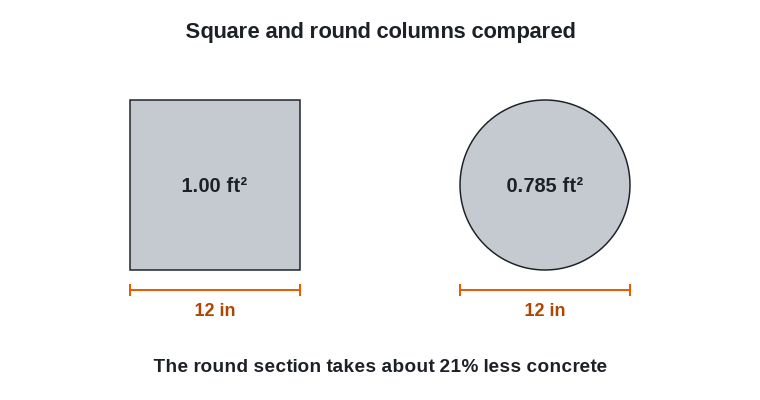
A 12 in square column 10 ft tall takes 10.00 ft3 of concrete. A 12 in diameter round column the same height takes 7.85 ft3. The round column uses about 21% less concrete for the same width and height.
The difference is pure geometry: a circle holds pi/4, or 0.785, of the area of the square that contains it. Learn that one ratio and every column and beam calculation becomes a simple volume formula. Check your result in the concrete column calculator.
Shape, not height, is where most estimates go wrong. People measure a round pier as if it were square, over-order, and never notice.
The vocabulary: column, pier, beam, and lintel #
A column is a vertical member that carries load mainly in compression, straight down to a footing below it. Columns support beams, floors, decks, and roofs from underneath.
A pier is a short, stocky column. Crews often use the word for a footing post under a deck or porch. They also use it for concrete in a round form tube set in an augered hole.
A pier and a column do the same job, and you calculate them the same way. The difference is proportion and context, not math.
A beam is a horizontal member that spans between supports and carries load in bending. In a reinforced concrete beam, the top concrete carries compression and the bottom concrete carries tension. Steel near the bottom does most of the tensile work.
A rectangular beam uses the same box math as a rectangular column, even though its structural job differs.
A lintel is a short beam over an opening, such as a door or window in a wall. For estimating, it is simply a small rectangular beam.
Rectangular and square columns: box math #
A rectangular column is a box: width x depth x height. Convert inches to feet first and the arithmetic stays clean.
The worked square column is 12 x 12 in and 10 ft tall: 1 ft x 1 ft x 10 ft = 10.00 ft3. Divide by 27 for cubic yards: 0.37 yd3.
In 80 lb bags, that single column is 17 bags. That figure helps you decide whether a small set of columns is a mixing job or a truck job.
The method handles any rectangular column. Double the height and you double the volume. Double one side of the cross-section and you double it too.
Most errors come from mixing units, such as multiplying feet by inches without converting. Convert every dimension to feet before you multiply, every time.
Rectangular columns need formwork: flat panels held square and braced against the pressure of fresh concrete. Square columns are common in buildings, where flat faces align with walls and finishes. They are less common for simple outdoor posts, where a tube form is faster.
Circular columns and piers: pi enters, volume drops #
A circular column is a cylinder: pi x radius squared x height. The radius is half the diameter, in feet like every other dimension.
The worked round column is 12 in in diameter and 10 ft tall. The radius is 6 in, or 0.5 ft: pi x 0.5^2 x 10 = pi x 0.25 x 10 = 7.85 ft3. In cubic yards, 7.85 / 27 = 0.29 yd3.
In 80 lb bags, 7.85 / 0.6 = 13.1, so round up to 14 bags. Bags always round up: a column poured short is a structural problem, not a cosmetic one.
Side by side: square is 10.00 ft3, round is 7.85 ft3. The round column uses about 21% less because pi/4 = 0.785.
Estimate a row of round piers with square math and you over-order by roughly that share on every pier. That error adds up fast across a deck or fence line.
Why choose round? An auger drills a round hole, and a cardboard tube form, the sonotube style used everywhere for deck and porch posts, is round. The tube drops into the hole and needs no flat-panel formwork.
Below grade, round is efficient and easy. Square columns win where flat faces matter. Finished interiors, porch columns that crews will wrap or trim flat, and any flat-to-flat joint all favor square.
Choose based on the job, then calculate based on the actual shape.
Beams: rectangular volume over a span #
A rectangular beam is also a box: width x depth x length of the pour. Depth is the vertical dimension.
People most often under-measure depth, because part of a beam may sit within or below a slab.
First example: an 8 in wide x 12 in deep beam over a 20 ft span pour. Convert the width to 8/12 ft; the depth is 1 ft. Volume is (8/12) x 1 x 20 = 13.33 ft3, which is 0.49 yd3, or 23 x 80 lb bags.
Second example, a heavier beam: 12 x 18 in over 24 ft. In feet that is 1 x 1.5 x 24 = 36 ft3, which is 1.33 yd3.
Two cautions belong with every beam estimate. First, count intersections once.
A beam poured monolithically with columns or walls shares volume at the junctions. Counting that volume once as column and again as beam inflates the order. On small residential work the overlap is minor, but you should know it exists.
Second, a beam's depth on a drawing may include the thickness of a slab it supports. If a separate slab calculation already counted the slab, the beam addition is only the part below the slab, the stem.
Clarify which convention your numbers use before ordering, especially on integrated slab-and-beam pours. See also how much concrete you need.
Formwork pressure and the honesty note #
Tall columns deserve a specific warning. Fresh concrete behaves like a heavy fluid until it sets. It pushes outward on column forms with pressure that grows with pour rate and height.
Pour too fast and forms can bulge, shift, or fail. Builders manage this risk with controlled lifts, proper bracing, and a watched pour rate. If a form moves during the pour, the finished column is out of plumb and the placed volume no longer matches the calculated volume.
This guide covers volume only. It tells you how much concrete a member of a given size contains. It does not tell you what size the member should be, how much steel it needs, or whether it will carry your load.
Sizing and reinforcement are engineering. Soil capacity, span, load, and code requirements all change the answer. No volume calculator, including ours on the homepage, substitutes for that work.
Order accurately for members that an engineer has already designed. For a square column, use width x depth x height. For a round column, use pi x radius squared x height, and expect about 21% less than the square version.
For a beam, use width x depth x span, counted once. Get the shape right, convert to feet before multiplying, and divide by 27 for yards. Round bags up, and that discipline eliminates most beam and column ordering mistakes.