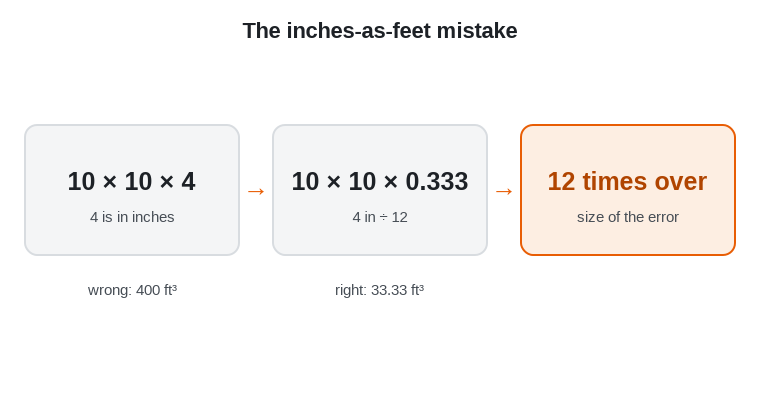
Most concrete money is lost before the truck arrives, in the arithmetic. The most expensive errors are simple. Mixing inches and feet can swing an order by 12 times.
Using diameter instead of radius quadruples a round slab. Skipping a waste allowance turns a $40 extra quarter-yard into a $200-plus second delivery. Every mistake below is one real crews make, with the numbers worked out so you can see exactly what each one costs.
None require advanced math: just one careful calculation in consistent units, checked against the checklist at the end.
The 9 mistakes #
1. Mixing up inches and feet #
Slab thickness comes in inches and everything else in feet, and that seam is where orders go wrong. A 10 x 10 foot slab at 4 inches thick is 10 × 10 × 0.333 feet, which is 33.33 cubic feet. Enter the 4 as feet instead of converting it and you get 400 cubic feet, 12 times too much concrete.
The reverse error is quieter and worse on pour day: treating a foot measurement as inches somewhere in the chain and under-ordering badly. Convert every thickness to feet first (4 inches is 0.333, 6 inches is 0.5), write it down, and only then multiply. The concrete calculator on the homepage handles the conversion for you if you enter thickness in inches where it asks for inches.
2. Ordering with no waste allowance #
A 20 x 20 foot slab at 4 inches works out to exactly 4.94 cubic yards. Ordering a flat 5.0 yards leaves almost nothing for reality.
Forms that bow slightly, a base that is not perfectly level, and normal spillage all eat into the load. Concrete also stays behind in the chute and pump.
When that slab runs short near the far corner, the fix is a second delivery. A second delivery commonly adds $200 or more in fees and minimums. The same insurance bought in advance is about $40 worth of extra concrete in a quarter-yard bump.
Order the calculated amount plus a waste allowance, typically rounding up to the next quarter or half yard. Leftover concrete is a nuisance; a short load is an expense.
3. Using diameter instead of radius #
Round slabs use pi × radius², and radius is half the diameter. On a 12-foot round patio, the radius is 6 feet. Use the 12 as the radius and the area becomes pi × 144 instead of pi × 36, exactly four times too large.
At 3 inches thick, the wrong math gives pi × 144 × 0.25, which is 113 cubic feet or 4.19 cubic yards. The correct figure is pi × 36 × 0.25, which is 28.3 cubic feet or 1.05 cubic yards.
That is more than 3 extra yards ordered for a small patio because of one wrong word. If a measurement came from pacing across the circle, it is a diameter. Halve it before you square it.
4. Skipping the dip in the base #
Your calculation assumes a perfectly level base at exactly the planned depth. Real bases have low spots.
If the subgrade sits just 1 inch low across a whole 12 x 12 foot slab, that hidden inch adds real volume. It is 12 × 12 × 1/12, an extra 12 cubic feet of concrete, another 0.44 cubic yards you did not order.
One low corner is a small overrun. A base that is low everywhere is a systematic one, and the truck does not care that your forms were right.
Measure depth in several places after compacting the base, and calculate from the average real depth. Keep the waste allowance from mistake 2 for what is left.
5. Ordering by bags for a truck job #
Bags are for small jobs. Scale one up and the math turns punishing: 5 cubic yards of concrete takes 223 bags at 80 pounds each.
At typical bag prices that is around $1,238 in bags, against roughly $850 for the same 5 yards delivered by truck. That price excludes hours of mixing, hauling, and disposing of 223 torn bags.
The crossover comes fast. Once a job passes about a yard, price the truck.
Bags still win for a post hole, a small pad, or a repair. A driveway in bags means paying a premium for the privilege of mixing it yourself.
6. Forgetting the fees around the concrete #
The per-yard price is not the invoice. Short-load fees of $40 to $100 apply below a plant's minimum load, and Saturday delivery can add a premium. Waiting time and pump charges appear on real tickets too.
Ask for the full delivered price when you order: yards, short-load fee if any, delivery, and any weekend or waiting charges. A slightly larger single weekday load can cost less than a smaller load with fees stacked on it.
7. Adding too much water on site #
This is a numbers mistake with no volume change. The water-to-cement ratio largely sets concrete strength: more water makes placement easier and the finished concrete weaker, permanently.
A load that arrives workable and gets hosed down at the chute places fast and cures soft. It also shrinks and cracks more, and its surface dusts and scales early. If the mix is too stiff to place, that is a mix design conversation with the plant, not a hose decision.
Order the slump you need and place what arrives. The yards were calculated correctly; do not un-calculate the strength.
8. Ignoring set time and the placement window #
A full truck carries up to about 9 cubic yards. Once it arrives, you have roughly a 90-minute placement window to get it placed and finished.
Ordering the full 9 yards for a slow two-person crew with a long wheelbarrow run is a logistics miscalculation. The last yards start setting up while you are still placing the first.
Match load size and crew size. Split a big pour into two loads timed back to back, add finishers, or shorten the haul path with a pump. Concrete that goes stiff in the forms costs removal, not just reordering.
9. Measuring the inside of the forms wrong #
The last mistake is measuring once and trusting it. A slab laid out as "12 x 12" may actually measure 12 x 13. One form may have drifted, or the tape may have read the outside of the form.
That slab is 12 × 13 × 0.333, or 52 cubic feet, against the 48 cubic feet you ordered for. That 4 cubic feet is another 0.15 cubic yards, right at the end of the pour where there is no slack.
Measure both dimensions in two places, and check the diagonals: on a rectangle, equal diagonals mean square corners. A form that is out of square is usually also out of dimension. Two minutes with a tape before the pour is the cheapest item on this entire list.
The 60-second pre-order checklist #
Run these five checks before you call the plant. They catch all nine mistakes above.
- Units: every thickness converted from inches to feet, or entered in inches only where the calculator asks for inches.
- Geometry: radius halved from diameter on round work, both slab dimensions measured twice, diagonals equal.
- Depth: base depth checked in several spots, not just at the forms.
- Quantity: calculated yards plus a waste allowance, rounded up to the next quarter or half yard.
- Total price: yards plus short-load, delivery, and weekend fees confirmed as one delivered number.
For the full step-by-step method behind the checklist, work through how much concrete do I need once with your own measurements. Ten careful minutes there is worth more than any fix available after the truck is rolling.