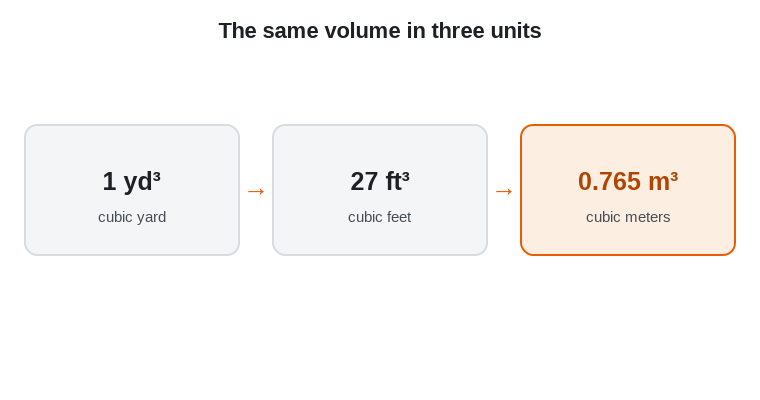
One cubic yard of concrete equals 27 cubic feet and 0.7646 cubic meters. That single line converts almost every concrete order you will place. Going the other way, 1 cubic meter equals 35.31 cubic feet and 1.308 cubic yards, and 1 cubic foot equals 0.037 cubic yards.
Keep those three relationships and you can move between plant orders, bag yields, and metric plans without guessing. The concrete yards calculator does the arithmetic for full project dimensions. This guide explains the units so you can spot a wrong number before it becomes a wrong delivery.
The three units and when each is used #
In the United States, ready-mix plants sell concrete by the cubic yard. If you call a plant and ask for cubic feet, they will convert it back to yards to dispatch a truck. Your estimate should arrive in yards, with waste included, ready to order.
Bags think in cubic feet. An 80 lb bag of concrete mix yields about 0.60 cubic feet when mixed.
Bag counts, mixer capacities, and small form volumes are all easier in cubic feet because the numbers stay human-sized. A 33.33 cubic foot slab is clearer than saying 1.23 cubic yards when you are counting bags.
The rest of the world uses cubic meters. Plans drawn outside the US, imported equipment specs, and many engineering documents state volume in cubic meters.
If a European spec calls for 2.5 cubic meters, you need 3.27 cubic yards from a US plant. Ordering 2.5 yards by mistake would leave you about three-quarters of a yard short.
Each unit is correct in its own context. Errors happen at the boundaries, when a number moves from feet to yards or from meters to yards without a proper conversion.
Conversion and coverage tables #
Start with the fixed relationships:
| Unit | Equals |
|---|---|
| 1 yd3 | 27 ft3 |
| 1 yd3 | 0.7646 m3 |
| 1 m3 | 35.31 ft3 |
| 1 m3 | 1.308 yd3 |
| 1 ft3 | 0.037 yd3 |
Full table for common order sizes:
| Cubic yards | Cubic feet | Cubic meters |
|---|---|---|
| 1 | 27 | 0.76 |
| 2 | 54 | 1.53 |
| 3 | 81 | 2.29 |
| 4 | 108 | 3.06 |
| 5 | 135 | 3.82 |
| 6 | 162 | 4.59 |
| 8 | 216 | 6.12 |
| 10 | 270 | 7.65 |
Coverage tells you what one yard actually does. Spread at a given thickness, 1 cubic yard covers:
| Thickness | Coverage of 1 yd3 |
|---|---|
| 1 in | 324 ft2 |
| 2 in | 162 ft2 |
| 3 in | 108 ft2 |
| 4 in | 81 ft2 |
| 6 in | 54 ft2 |
That coverage table is the fastest sanity check for a slab quote. If someone tells you one yard will cover a 10x10 slab at 4 inches, check it.
You need 100 square feet, and one yard covers 81 square feet at 4 inches, so one yard is not enough. You need about 1.23 yards before waste.
For bags, remember that 1 cubic foot takes 1.67 bags of 80 lb mix, because 1 / 0.60 = 1.67. A 27 cubic foot yard therefore takes about 45 bags, which matches the standard bag-per-yard figure used across this site.
Five worked conversions #
First, a 5 cubic yard pour in other units. Five yards is 5 x 27 = 135 cubic feet, and 5 x 0.7646 = 3.82 cubic meters. Use this when a metric plan needs to match a US order, or when you are comparing mixer and form volumes stated in feet.
Second, a 2.5 cubic meter European spec converted for a US plant. Multiply by 1.308: 2.5 x 1.308 = 3.27 cubic yards. Add waste before ordering, because the conversion gives you net volume, not the final order quantity.
Third, cubic feet to yards for a slab. A 10x10 slab at 4 inches is 33.33 cubic feet. Multiply by 0.037: 33.33 x 0.037 = about 1.23 cubic yards, or divide by 27 for the same result: 33.33 / 27 = 1.23 yards.
Fourth, yards to bags. One cubic foot needs 1.67 bags of 80 lb mix, so a 33.33 cubic foot slab needs 33.33 x 1.67 = about 56 bags. That matches the direct bag calculation and gives you a cross-check between the two methods.
Fifth, coverage to yards. Take a 324 square foot area at 4 inches. Each yard covers 81 square feet at 4 inches, so 324 / 81 = 4 cubic yards net.
Add waste and order 4.5 yards in practice, subject to your plant's increments and minimums.
Work through one conversion by hand even if you use the concrete yards calculator for the final number. The hand check catches unit mistakes that a calculator cannot, because a calculator will faithfully convert the wrong input.
Error clinic: the three errors that wreck orders #
Error one is dividing by 9 instead of 27. Nine is the conversion for square yards: 1 square yard = 9 square feet.
Concrete volume is cubic, not square, so the divisor is 27. Dividing cubic feet by 9 triples your yardage and produces a massive over-order.
Error two is using inches as feet. A 4 inch slab thickness is 0.33 feet.
If you multiply length x width x 4 instead of x 0.33, your volume is 12 times too large. Always convert thickness to feet first, or use a calculator that accepts inches directly, like the tools linked from the homepage.
Error three is using diameter as radius for round pours. Volume for a cylinder uses the radius, which is half the diameter.
Using the diameter in place of the radius makes the area four times too large, because the formula squares the radius. A 12 inch tube has a 6 inch radius, not a 12 inch radius. This error alone can turn a 6-bag tube into a 24-bag estimate.
A quieter fourth error is forgetting waste after a perfect conversion. Conversions move a net volume between units exactly. They do not add anything for spillage, uneven subgrade, or forms that are slightly out of level.
Convert first, then add waste, then round to an orderable quantity. See how much concrete do I need for the waste allowances for different pour types.
Keep 27 cubic feet per yard, 0.7646 cubic meters per yard, and 1.308 yards per cubic meter in front of you. With those three numbers, you can verify any quote, bag count, or metric plan in under a minute. That verification is the cheapest quality control in the entire project.