Concrete Steps Calculator
Concrete steps are a stack of boxes, not a slab with a funny shape. This concrete stair calculator does the stacking math for you.
Free · Instant results as you type · No sign-up
Live preview
Your estimate
Updates as you typeIncludes a 10% waste allowance on top of the exact geometric volume (1.19 yd³). Bag counts are rounded up, because you cannot buy part of a bag.
Enter the step count, the riser height, and the tread depth from front to back. Enter the staircase width. You get the exact volume in cubic feet, cubic yards, and pre-mix bag counts.
The defaults match the most common residential porch stair in the US. It has 5 steps with 7 in risers, 11 in treads, and a 4 ft width.
Count your steps carefully before you order. Most people count the visible treads and forget the top step. That top step is the porch or landing level itself.
Measure the total rise first. Then work out how many risers divide that rise evenly, as described below.
How This Calculator Works
Picture the staircase from the side. The bottom step is one box, one riser tall and one tread deep. The next step up is two boxes, and the next is three.
With n steps, the stack holds 1 + 2 + … + n boxes, or n(n+1)/2. Multiply that count by the volume of one box: riser × tread × width. That product gives you the staircase volume.
For the 5-step default, the multiplier is 5 × 6 ÷ 2 = 15 boxes. The calculator converts riser and tread from inches to feet and multiplies through. It then converts to cubic yards and to bags at 0.60 ft³ per 80 lb bag.
Code limits shape the numbers you should enter. For residential work, the maximum riser height is 7.75 in. The minimum tread depth is 10 in.
All risers in one flight must be uniform. The tallest and shortest riser may differ by no more than 3/8 in. Uneven risers create a tripping hazard.
Your legs learn the rhythm of the first two steps. Measure the real total rise first: floor to floor, or floor to grade for porch steps.
Divide the total rise by your target riser height to get the step count. Round the count to a whole number. Then divide again so every riser comes out exactly equal.
A landing is not part of this math. If your stairs turn or pause at a landing, calculate the landing separately as a slab. Add the two volumes together.
For formwork, each step gets a riser board held by stakes and cleats. Reinforce the whole staircase and dowel it into the slab or porch it meets. Unconnected steps settle at a different rate and open a crack at the joint.
Keep the 10% waste allowance. Step forms leak at corners. The stack-of-boxes math assumes perfectly sharp internal corners.
Formula: Volume = width x riser x tread x n(n+1)/2, where n = number of steps (each step adds one more layer than the one below).
Worked Example: Five porch steps: 7 in risers, 11 in treads, 4 ft wide
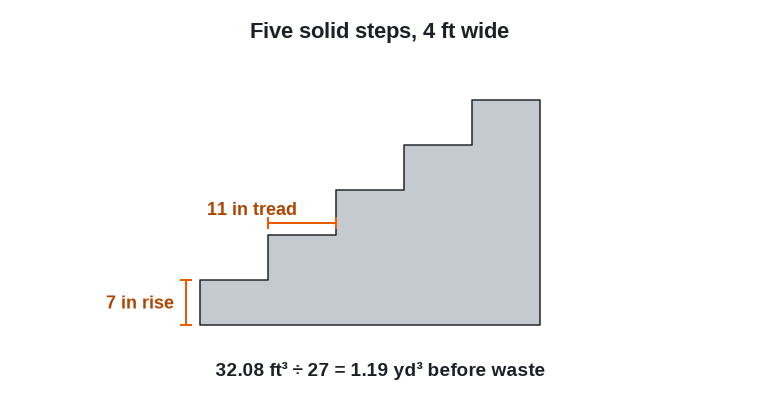
- Count the layers: with 5 steps the stack multiplier is 5 × 6 ÷ 2 = 15 boxes.
- One box: (7 ÷ 12) ft × (11 ÷ 12) ft × 4 ft = 2.14 ft³.
- Multiply: 15 × 2.14 = 32.08 ft³ of concrete.
- Convert to yards: 32.08 ÷ 27 = 1.19 yd³; with 10% waste, 1.31 yd³ to order.
- In bags: 32.08 ÷ 0.60 = 54 × 80 lb bags before waste.
Result: 1.19 yd³ exact, 1.31 yd³ with 10% waste, or 54 × 80 lb bags before waste.
Common Stair Runs (7 in riser, 11 in tread, 4 ft wide, before waste)
| Steps | Cubic feet | Cubic yards | 80 lb bags |
|---|---|---|---|
| 3 steps | 12.83 ft³ | 0.48 yd³ | 22 bags |
| 4 steps | 21.39 ft³ | 0.79 yd³ | 36 bags |
| 5 steps | 32.08 ft³ | 1.19 yd³ | 54 bags |
| 6 steps | 44.92 ft³ | 1.66 yd³ | 75 bags |
| 8 steps | 77.00 ft³ | 2.85 yd³ | 129 bags |
Frequently Asked Questions
How much concrete do I need for 4 steps?
At the table's standard dimensions (7 in risers, 11 in treads, 4 ft wide), 4 steps take 21.39 ft³. That is 0.79 cubic yards, or 36 × 80 lb bags before waste. Add 10% waste and plan on about 0.87 yd³ or 40 bags.
What is the maximum riser height for concrete steps?
For residential stairs, the code maximum is 7.75 in per riser. The minimum tread depth is 10 in. For outdoor steps, target a 6 to 7 in riser with an 11 to 12 in tread, and keep risers uniform within 3/8 in.
Why do concrete steps crack at the inside corner?
The re-entrant inside corner, where a tread meets the next riser, concentrates stress. Steps settle separately from the porch or slab they meet, so form a control joint where steps meet the landing. Dowel the staircase into the adjacent slab with rebar and keep reinforcement continuous through the steps.
How do I calculate concrete for a landing?
Calculate the landing separately as a slab, length × width × thickness (usually 4 in), using the slab calculator. Add that volume to the staircase volume before you order. For a thickened block at the foot of the steps, measure its own box: length × width × full depth.
How much do concrete steps cost?
For materials only, the 5-step staircase (1.31 yd³ with waste) costs about $225 in ready-mix at $170 per yard. The same concrete runs roughly $300 to $325 in 80 lb pre-mix bags: 54 bags before waste, about 59 with it. As a concrete steps cost calculator shows, hired porch steps run $300 to $600 per step installed, mostly for formwork labor.
Are precast concrete steps a better option?
For 1 to 3 steps, precast often wins: you set a unit on a small footing or gravel pad in an hour. It needs no forming, pouring, or cure time, and the yardage math disappears. For longer runs, wide stairs, or exact floor heights, cast-in-place wins, because fixed precast rises rarely match your total rise.