Concrete Pad Calculator
A concrete pad is a purpose-built slab that carries one load: a hot tub, a shed, a generator, an AC condenser, or a small outbuilding. Enter the pad length, width, and thickness, and the calculator returns cubic yards, pre-mix bag counts, total weight, and a material cost estimate. The defaults, 12 × 12 ft at 6 in thick, suit a hot tub pad, the most common load-critical pad homeowners pour.
Free · Instant results as you type · No sign-up
Live preview
Your estimate
Updates as you typeIncludes a 10% waste allowance on top of the exact geometric volume (2.67 yd³). Bag counts are rounded up, because you cannot buy part of a bag.
Pads fail differently from patios, because a patio only carries people and furniture. A filled six-person hot tub can exceed 5,000 lb on about 50 ft², and a shed concentrates its load on the walls and skids. So thickness and reinforcement matter more than yardage, and this page pairs the volume math with thickness, base, and footing guidance that stops point-load cracking.
How This Calculator Works
The math matches any slab: convert thickness to feet, multiply length × width × thickness for cubic feet, and divide by 27 for cubic yards. Wet yields per bag: 0.60 ft³ (80 lb), 0.45 ft³ (60 lb), 0.375 ft³ (50 lb), 0.30 ft³ (40 lb). The calculator adds the waste allowance on top of the exact geometric volume, because hand-dug pads are never perfectly level and over-excavation is almost universal.
Thickness follows the load, not the area, so light equipment pads for a generator or AC condenser do fine at 3 to 4 in. Pour a shed pad 4 in thick, and give a hot tub pad 6 in with welded wire mesh or a #4 rebar grid. A hot tub bears 5,000 lb or more nonstop, so settlement cracks the shell; drive-on pads for trailers and RVs need 5 to 6 in.
Excavate to firm soil, then place 4 to 6 in of gravel base and compact it in lifts, not dumped loose. The gravel levels the subgrade, drains water away from the underside, and gives a uniform bearing surface that stops one corner from sinking. In frost climates, check whether the pad needs footings turned down below the frost line, since uneven heave can crack a rigid hot tub.
Formula: Volume = Length × Width × Thickness (all in feet) · Cubic yards = Cubic feet ÷ 27 · Bags = Cubic feet ÷ yield per bag
Worked Example: A 12 × 12 ft hot tub pad, 6 in thick
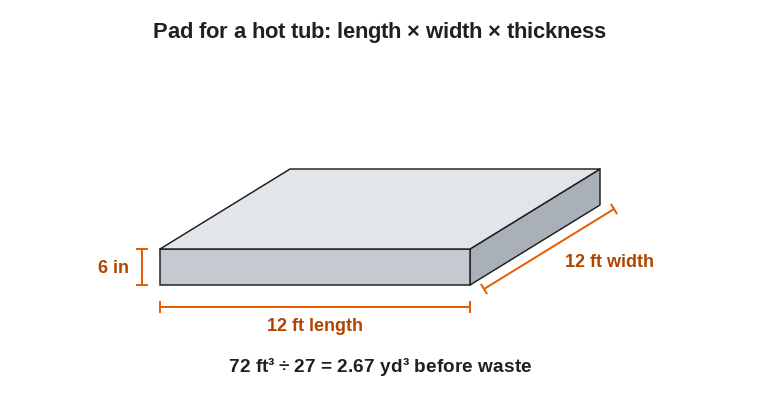
- Convert the thickness: 6 in ÷ 12 = 0.5 ft.
- Multiply: 12 ft × 12 ft × 0.5 ft = 72 ft³.
- Convert to yards: 72 ÷ 27 = 2.67 yd³ of concrete.
- Add 10% waste: 2.67 × 1.10 = 2.93 yd³, so order 3 yd³ from the ready-mix plant.
- In bags, the same pad takes 72 ÷ 0.60 = 120 bags of 80 lb before waste, or 132 with waste. That is ready-mix truck territory once you count mixing, moving, and placing more than four tons of dry mix.
Result: 2.67 yd³ exact, 2.93 yd³ with 10% waste (order 3 yd³), or 120 × 80 lb bags before waste, 132 with waste.
Pad Sizes (4 in thick, before waste)
| Pad size | Cubic feet | Cubic yards | 80 lb bags |
|---|---|---|---|
| 8 × 10 ft | 26.67 ft³ | 0.99 yd³ | 45 bags |
| 10 × 12 ft | 40.00 ft³ | 1.48 yd³ | 67 bags |
| 12 × 12 ft | 48.00 ft³ | 1.78 yd³ | 80 bags |
| 12 × 16 ft | 64.00 ft³ | 2.37 yd³ | 107 bags |
Frequently Asked Questions
What is the difference between a concrete pad and a slab?
The math is identical: both are length × width × thickness. In practice, a 'pad' is a smaller slab poured for one job, while a 'slab' is a larger structural floor or foundation element. Use the same calculator for either; the load alone sets the thickness and reinforcement required.
How thick should a hot tub pad be?
Pour a hot tub pad 6 in thick with welded wire mesh or #4 rebar, over 4 to 6 in of compacted gravel. A filled six-person hot tub can exceed 5,000 lb, and that load never leaves the pad. A standard 4 in patio slab is not enough, because it can crack or settle under the sustained weight.
How thick should a generator or AC pad be?
Three to four inches is enough for a standby generator or air-conditioning condenser pad. The load is a few hundred pounds spread across the unit's frame. Install a 4 in pad on a compacted gravel base and slope it slightly away from the house for drainage.
How deep should the gravel base be under a pad?
Use 4 to 6 in of compacted gravel under most pads. Go 4 in for light equipment and shed pads, and 6 in under a hot tub or vehicle pad. Compact it in two lifts with a plate compactor or hand tamper, because the base, not extra concrete, prevents differential settlement.
Does a concrete pad need footings?
A light floating pad for a shed or AC unit usually does not need footings. In frost climates or under heavy concentrated loads like a hot tub, local code may require footings below the frost line. Set them 12 to 48 in deep depending on climate, so frost heave lifts the whole pad evenly instead of cracking one corner.
Related Calculators
Helpful Guides
Concrete Bags
How Many Bags of Concrete for a 10x10 Slab? (+ Common Slab Sizes)
How many bags of concrete for a 10x10 slab? A 4 inch slab needs 56 bags of 80 lb mix, or 62 with waste. See the size chart and thickness math.
Read guideSlab & Flatwork
How to Calculate Concrete for a Slab
Calculate concrete for any slab: convert thickness to feet, multiply, divide by 27, add waste. Worked example, size chart and the subgrade mistake to avoid.
Read guideSlab & Flatwork
How Thick Should a Concrete Slab Be? (4 in vs 6 in)
Four inches for patios, 5 to 6 for driveways and garages, but base quality beats extra thickness. Thickness table, the 2x4 trap and what extra costs.
Read guide