Self-Leveling Concrete Calculator
Self-leveling underlayment (SLU) is a bagged, polymer-modified cement product. It pours like thick pancake batter and seeks its own level. It turns a wavy, patched, or out-of-flat floor into a flat surface.
Free · Instant results as you type · No sign-up
Live preview
Your estimate
Updates as you typeBased on a 0.45 ft³ yield per 50 lb bag. Depths over 1 in usually need two lifts and an aggregate extension. Check the product data sheet.
The finished surface suits tile, LVP, laminate, or engineered wood. This calculator takes your floor area and average pour depth. It returns the number of 50 lb bags to buy, the unit these products sell in.
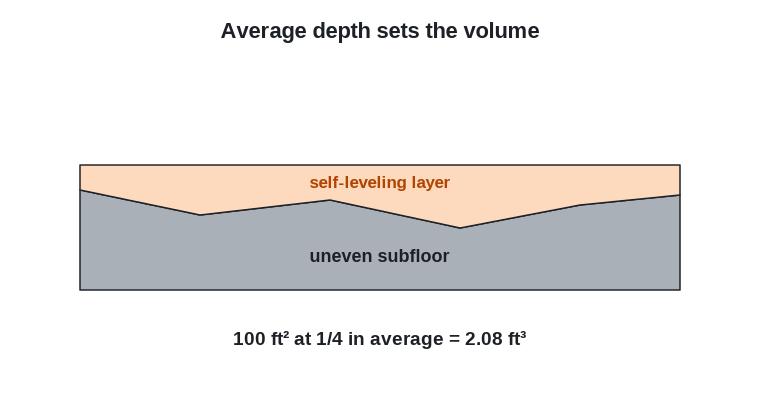
Two things catch first-timers. First, depth means the average depth across the floor, not the deepest low spot. A room 1/2 in low in one corner and flat elsewhere might average only 3/16 in.
An underlayment is not a wear surface, so you must cover it with a finished floor. Overlayments are the decorative, walk-on cousins. The bag math is the same, but never leave a standard underlayment exposed.
How This Calculator Works
The calculator multiplies area by depth, with depth in feet. At 1/4 in (0.0208 ft) over 100 ft², you get 2.08 ft³ of material. A standard 50 lb bag yields about 0.45 ft³ placed.
Divide cubic feet by 0.45 to get the bag count, and always round up. You cannot stop mid-room because you ran a bag short. Coverage works the same way in reverse.
One bag covers about 21.6 ft² at 1/4 in and 14.4 ft² at 3/8 in. At a full 1 in, one bag covers only 5.4 ft². Depth control is money control on these pours.
Measure the average depth honestly. Run a laser level or a long straightedge over the floor on a grid. Note the gap at each point and average the readings.
Or stretch strings corner to corner and measure down to the slab every few feet. The product maximum depth must still cover your deepest point. The bag count comes from the average.
Prime first, because primer is mandatory on most substrates. It seals porous concrete so the slab does not suck water from the mix. It also bonds the underlayment to plywood, cutback residue, or old adhesive.
Skipping primer is the leading cause of debonding and cratering.
On pour day, seal and dam every hole, pipe penetration, floor drain, and door threshold. This material finds gaps like water, because it nearly is water. Working time runs roughly 15 to 20 minutes per mix before it stiffens.
For anything over a small bathroom, use two people. One person mixes continuously. The other pours and spreads with a gauge rake and a smoothing tool.
Bags typically run $30 to $45 each. The 14-bag kitchen in the example costs $420 to $630 in materials before primer. Measure twice before you order.
Formula: Volume = Area (ft²) × Average depth (ft) · Bags of 50 lb = Cubic feet ÷ 0.45 ft³ per bag, rounded up · Coverage per bag = 0.45 ÷ depth in feet
Worked Example: A 100 ft² room at 1/4 in average depth
- Convert the depth: 1/4 in = 0.0208 ft.
- Volume: 100 ft² × 0.0208 ft = 2.08 ft³ of underlayment.
- Bags: 2.08 ÷ 0.45 ft³ per 50 lb bag = 4.63, which rounds up to 5 bags.
- Same room at 3/8 in average: 100 × 0.03125 = 3.13 ft³ → 7 bags.
- Scale check: a 200 ft² kitchen at 3/8 in gives 6.25 ft³, or 14 bags.
Result: You need 5 × 50 lb bags for 100 ft² at 1/4 in average depth. You need 7 bags at 3/8 in, and 14 bags for a 200 ft² room at 3/8 in.
Coverage per 50 lb Bag by Pour Depth (0.45 ft³ yield per bag)
| Pour depth | Coverage per bag |
|---|---|
| 1/8 in | 43.2 ft² |
| 1/4 in | 21.6 ft² |
| 3/8 in | 14.4 ft² |
| 1/2 in | 10.8 ft² |
| 1 in | 5.4 ft² |
Frequently Asked Questions
How many bags of self-leveler for 100 square feet?
At 1/4 in average depth, 100 ft² needs 2.08 ft³ of material, or 4.63 bags, so buy 5 bags of 50 lb. At 1/2 in average depth, the same room needs 4.17 ft³, or 9.26 bags, so buy 10. Always round up and keep one spare bag, because a stopped pour leaves a visible seam.
Do I really need primer under self-leveling underlayment?
Yes, on almost every substrate, and let the same brand's primer dry to the tack or clarity the label specifies. It seals porous concrete so the slab cannot rob the mix of water, and it prevents pinholes and craters. It bonds the underlayment to plywood, tile backer, and adhesive residue, and most manufacturers void their warranty without it.
How deep can I pour self-leveler in one lift?
Most standard underlayments rate to about 1 in neat, with no added aggregate, in a single lift. Some products reach 2 in or more, and many allow deeper pours extended with pea gravel. Check your bag's data sheet, because exceeding the rated depth causes cracking, soft spots, and debonding that appears later.
Can self-leveling concrete go over plywood?
Yes, with the right system: a stiff plywood subfloor, the manufacturer's primer for wood, and often stapled metal lath. Deflection matters more than the product, and many products require lath over plywood. Read your bag's substrate list, because brands differ and many prohibit OSB and particleboard.
What is the difference between underlayment and overlayment?
Underlayment and overlayment are bagged and poured similarly, but an underlayment is a leveling layer that must be covered. It cannot resist foot traffic, chair legs, or UV, and it will wear and dust if left exposed. An overlayment is the decorative version, designed and sealed as the finished floor people walk on.
Related Calculators
Helpful Guides
Concrete Bags
How Many Bags of Concrete for a 10x10 Slab? (+ Common Slab Sizes)
How many bags of concrete for a 10x10 slab? A 4 inch slab needs 56 bags of 80 lb mix, or 62 with waste. See the size chart and thickness math.
Read guideSlab & Flatwork
How to Calculate Concrete for a Slab
Calculate concrete for any slab: convert thickness to feet, multiply, divide by 27, add waste. Worked example, size chart and the subgrade mistake to avoid.
Read guideSlab & Flatwork
How Thick Should a Concrete Slab Be? (4 in vs 6 in)
Four inches for patios, 5 to 6 for driveways and garages, but base quality beats extra thickness. Thickness table, the 2x4 trap and what extra costs.
Read guide