Concrete Mix Calculator
This concrete mix calculator proportions a site-mixed batch from a ratio. Enter the finished volume in cubic yards and choose a cement : sand : aggregate ratio. It returns 94 lb bags of cement, sand and aggregate in cubic yards and tons, and the mixing water.
Free · Instant results as you type · No sign-up
Live preview
Your estimate
Updates as you typeRatio 1:2:3 by volume, using the standard 1.54 dry-volume factor. Water assumes a 0.50 water-cement ratio. Add water gradually; excess water weakens concrete.
Use it when you are batching from bulk materials with a mixer rather than ordering ready-mix or pre-mix bags. It is the site-mix counterpart to a ready mix concrete calculator: same target volume, proportioned from bulk ingredients instead of batched at a plant.
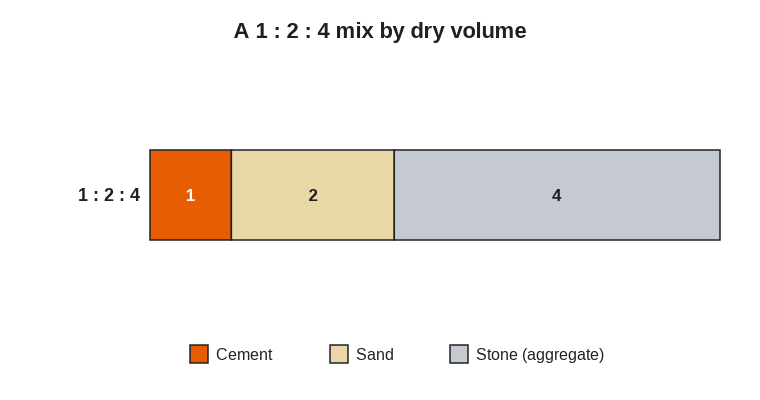
A mix ratio such as 1 : 2 : 4 describes parts by loose volume: one part cement, two parts sand, four parts coarse aggregate. The leaner the ratio (more aggregate per bag of cement), the cheaper and weaker the concrete.
But the ratio alone does not set strength. The water-cement ratio and proper curing matter as much, so the ratios below carry approximate PSI figures, not guarantees.
How This Calculator Works
The calculator uses the dry-volume method and multiplies wet volume by 1.54, because loose dry ingredients bulk larger than hardened concrete. One cubic yard of placed concrete needs 27 × 1.54 = 41.58 ft³ of dry material, and the ratio splits that total in proportion.
A 1 : 2 : 4 mix has seven total parts: cement 1/7, sand 2/7, aggregate 4/7. Cement converts to bags at 94 lb per ft³.
The water-cement (w/c) ratio really controls strength. Cement needs a w/c of only about 0.25 to 0.30 to fully hydrate. Crews add extra water for workability, but every extra gallon dilutes the paste and lowers the final PSI.
A 1 : 2 : 3 mix at w/c 0.50 reaches roughly 3,500 PSI. Flood the same ratio to w/c 0.80 and strength can fall below 2,000 PSI. Keep the water at the calculated figure and use a plasticizer, not more water, if you need the mix to flow.
Pick the ratio by the job. Lean 1 : 3 : 6 (about 1,500 PSI) is for blinding, fill and non-structural mass concrete. 1 : 2 : 4 (about 2,500 to 3,000 PSI) suits foundations, footings and ground slabs without vehicle loads.
1 : 2 : 3 (about 3,500 PSI) is the standard for driveways, garage floors, and structural flatwork. 1 : 1.5 : 3 (about 4,000 PSI) suits heavy-duty or thin, highly loaded work. All PSI figures are approximate 28-day values and assume proper placement and at least 7 days of moist curing.
Run as a 1:2:4 concrete mix calculator, it returns 6 cement bags, 0.44 yd³ of sand, and 0.88 yd³ of aggregate per yard. The worked example below shows that arithmetic in full.
Formula: Dry volume = Wet volume × 1.54 · Each ingredient = Dry volume × its parts ÷ total parts · 94 lb bags = Cement ft³ (1 ft³ cement = 94 lb = 1 bag)
Worked Example: 1 cubic yard of concrete at a 1 : 2 : 4 mix
- Dry volume: 1 yd³ × 27 ft³ × 1.54 = 41.58 ft³ of loose dry material.
- Total parts: 1 + 2 + 4 = 7.
- Cement: 41.58 × 1/7 = 5.94 ft³. Buy 6 × 94 lb bags.
- Sand: 41.58 × 2/7 = 11.88 ft³ = 0.44 yd³, about 0.59 tons.
- Aggregate: 41.58 × 4/7 = 23.76 ft³ = 0.88 yd³, about 1.19 tons.
- Water: at a 0.50 water-cement ratio, the 558 lb of cement takes about 279 lb of water, 33.5 gallons.
Result: Per cubic yard at 1 : 2 : 4: 6 × 94 lb bags of cement, 0.44 yd³ of sand and 0.88 yd³ of aggregate. Add about 33.5 gallons of water.
Common concrete mix ratios, typical uses and approximate strength
| Ratio | Typical use | Approx strength |
|---|---|---|
| 1 : 4 : 8 | Blinding under foundations, leveling fill | ~1,000 PSI |
| 1 : 3 : 6 | Lean mix, non-structural fill, sub-bases | ~1,500 PSI |
| 1 : 2 : 4 | Foundations, footings, plain ground slabs | ~2,500 to 3,000 PSI |
| 1 : 2 : 3 | Driveways, garage floors, general structural work | ~3,500 PSI |
| 1 : 1.5 : 3 | High-strength work, heavy loads, thin sections | ~4,000 PSI |
Frequently Asked Questions
What is the best mix ratio for a concrete slab?
For a driveway or garage slab that carries vehicles, use 1 : 2 : 3 at a water-cement ratio near 0.50, about 3,500 PSI. For a patio, walkway, or shed floor with no vehicle loads, 1 : 2 : 4 (about 2,500 to 3,000 PSI) is enough. It saves roughly a bag of cement per cubic yard, and subgrade, thickness, and curing affect real-world performance as much as the ratio.
What happens if I add too much water to concrete?
Excess water is the most common site mistake, and it raises the water-cement ratio and lowers strength sharply. Moving from 0.50 to 0.80 can cut 28-day strength by 40% or more and increase shrinkage cracking, surface dusting, and freeze-thaw damage. A mix that looks too stiff loosens after a minute of mixing, so wait and add water a quart at a time if you must.
Can I make concrete stronger just by adding more cement?
Only up to a point: a richer mix (for example, 1 : 2 : 4 to 1 : 1.5 : 3) does raise strength. But past a certain cement content, the gains flatten while cost, heat of hydration, and shrinkage cracking keep rising. If you need a specific strength, lower the water-cement ratio first: that lever has the biggest effect per dollar.
What is the difference between a mix ratio and a PSI rating?
A ratio (1 : 2 : 3) is a recipe by volume that you control on site, and it only approximates a PSI. A PSI rating (for example, 3,500 PSI) is a tested 28-day compressive strength: what ready-mix plants sell and what building codes specify. Actual strength also depends on the water-cement ratio, aggregate quality, and curing, so order by PSI from a plant for inspected structural work.
How do I measure mix parts accurately on site?
Use the same container for every ingredient, usually a five-gallon bucket, and fill it the same way each time: loose, struck level, no tamping. Counting shovelfuls is unreliable because a heaped shovel of sand and one of aggregate are different volumes, and the error compounds across a batch. Batch by bucket, keep the cement in whole or carefully halved bags, and measure water with a marked container rather than a free-running hose.