Cement Calculator
As a cement calculator for concrete batching, this page works out how much Portland cement a site-mixed batch actually needs. Enter the finished concrete volume in cubic yards and pick a mix ratio. The calculator returns the 94 lb bags of cement plus the sand, aggregate, and water that go with them.
Free · Instant results as you type · No sign-up
Live preview
Your estimate
Updates as you typeRatio 1:2:3 by volume, using the standard 1.54 dry-volume factor. Water assumes a 0.50 water-cement ratio. Add water gradually; excess water weakens concrete.
It is built for site mixing with bulk materials, not for counting pre-mix bags. If you are buying bagged concrete, use the bag calculator instead.
If you came looking for a cement calculator for slab work, you are in the right place. Take the slab yardage from the slab calculator first, then bring that volume here.
Cement and concrete are not the same thing, and the distinction drives every number here. Cement is the dry binder ingredient: the powder that reacts with water and glues the mix together. Concrete is the finished material: cement plus sand, aggregate and water.
Cement makes up only about 10 to 15% of the concrete by volume. So a cubic yard of concrete needs roughly 6 or 7 bags of cement, not a yard of cement.
How This Calculator Works
Site mixing uses the dry-volume method. Loose dry ingredients occupy more space than the wet concrete they become. Sand and cement settle into the voids between aggregate particles.
So you multiply the wet volume by a dry-volume factor of 1.54 to get the loose material to order. One cubic yard of finished concrete therefore starts as 27 × 1.54 = 41.58 ft³ of dry ingredients.
For a 1 : 2 : 3 mix, the ratio splits the dry volume into 6 total parts. Cement takes 1/6 of 41.58 ft³, sand takes 2/6, and aggregate takes 3/6. One cubic foot of Portland cement weighs 94 lb, exactly one standard US bag, so cement in cubic feet equals bags, rounded up.
The calculator reports sand and aggregate in cubic yards for ordering and in tons for the scale, at about 1.35 tons per cubic yard each.
The calculator estimates water from a water-cement ratio of about 0.50 by weight. That ratio lets the cement hydrate and keeps the mix workable without the strength loss that flooding causes. Keep water near that figure even if the mix looks stiff at first.
Formula: Dry volume = Wet volume × 1.54 · Cement ft³ = Dry volume × cement parts ÷ total parts · 94 lb bags = Cement ft³ (1 ft³ cement = 94 lb = 1 bag)
Worked Example: 2 cubic yards of concrete at a 1 : 2 : 3 mix
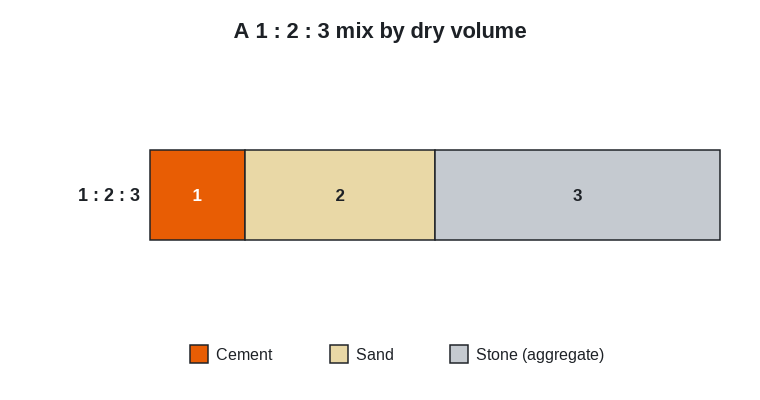
- Dry volume: 2 yd³ × 27 ft³ × 1.54 = 83.16 ft³ of loose dry material.
- Total parts: 1 + 2 + 3 = 6, so cement takes 1/6 of the dry volume.
- Cement: 83.16 × 1/6 = 13.86 ft³. At 94 lb per ft³ that is 13.86 bags. Buy 14 × 94 lb bags.
- Sand: 83.16 × 2/6 = 27.72 ft³ = 1.03 yd³, about 1.39 tons.
- Aggregate: 83.16 × 3/6 = 41.58 ft³ = 1.54 yd³, about 2.08 tons.
- Water: at a 0.50 water-cement ratio, the 1,303 lb of cement needs about 652 lb of water, roughly 78 gallons.
Result: For 2 yd³ at 1 : 2 : 3: 14 × 94 lb bags of cement, 1.03 yd³ of sand and 1.54 yd³ of aggregate. Add about 78 gallons of water.
Cement calculator: bags per cubic yard of concrete by mix ratio (dry-volume method)
| Mix ratio | Cement per yd³ | 94 lb bags to buy |
|---|---|---|
| 1 : 1.5 : 3 (high strength) | 7.56 ft³ | 8 bags |
| 1 : 2 : 3 (general purpose) | 6.93 ft³ | 7 bags |
| 1 : 2 : 4 (foundations and footings) | 5.94 ft³ | 6 bags |
| 1 : 3 : 6 (lean mix / fill) | 4.16 ft³ | 5 bags |
Frequently Asked Questions
How many bags of cement do I need for 1 cubic yard of concrete?
The dry-volume method gives 7 × 94 lb bags per cubic yard at a 1 : 2 : 3 mix, and 8 bags at 1 : 1.5 : 3. It gives 6 bags at 1 : 2 : 4 and 5 bags at the lean 1 : 3 : 6 mix. Always round up to whole bags, because a batch short on cement cannot be fixed after placement.
What is the difference between a bag of cement and a bag of concrete?
A 94 lb bag of Portland cement is pure binder: no sand or stone in it. A bag of pre-mix concrete (40, 50, 60 or 80 lb) already contains cement, sand and aggregate in proportion; you only add water. Cement bags are for site-mixing with separate bulk sand and aggregate, or for making mortar and custom mixes.
Why is a bag of cement 94 lb?
The weight is not arbitrary: one cubic foot of Portland cement weighs 94 lb, and the standard US bag holds exactly one cubic foot. That makes site math simple: cement in cubic feet equals cement in bags. Other countries use different standards, commonly 50 kg (about 110 lb) bags.
How much sand and aggregate go with each bag of cement?
Each 94 lb bag holds 1 ft³ of cement, about 2 ft³ of sand and 3 ft³ of aggregate at a 1 : 2 : 3 mix. That is roughly two five-gallon buckets of sand and three of aggregate. Add about 5.5 gallons of water at a 0.50 water-cement ratio, and scale every ingredient by the same factor when you change batch size.
How much is a bag of cement?
A 94 lb bag of Portland cement typically costs about $11 to $17 at US home centers and building suppliers in 2026. Pallet pricing runs lower per bag, and that price buys the binder only. Pre-mix concrete is a different product: an 80 lb bag with cement, sand, and aggregate already combined runs roughly $4 to $7.
How long does bagged cement keep?
Unopened cement bags stored dry, off the ground and under cover keep their full strength for about 3 months. After that the powder slowly absorbs moisture and CO2 from the air and loses strength, even if it still looks fine. Bags with hard lumps that do not crumble between your fingers should go to non-critical fill or the trash, never structural work.