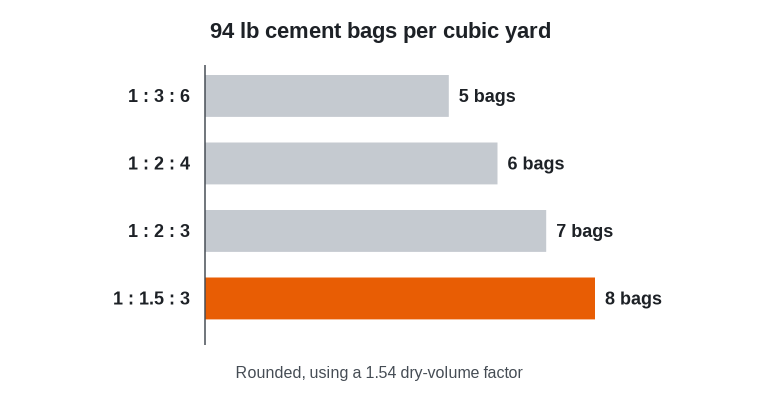
Take the wet volume of concrete and multiply it by 1.54 to get the dry volume of ingredients. Split that dry volume by your mix ratio. Then divide the cement share by 1 cubic foot.
One 94 lb bag of cement equals 1 cubic foot. For a full cubic yard of 1:2:3 concrete, the math gives 7 bags of cement. The yard also needs the sand and aggregate the ratio calls for.
This guide walks through the method step by step and gives per-yard answers for the four common ratios. It also works two complete examples, so you can check your own numbers against them.
You can also run any volume and ratio in the cement calculator.
The formula, step by step #
Step 1: Start with wet volume #
Wet volume is the finished size of what you are casting, in cubic feet or cubic yards. Measure the space the hardened concrete will occupy, whether you cast a slab, a footing, or a column. One cubic yard is 27 cubic feet.
Step 2: Convert to dry volume with 1.54 #
Dry ingredients take up more room than the finished concrete. Sand settles into the gaps between aggregate, and cement fills the remaining voids. Water then brings the mix together.
You need roughly 1.54 cubic feet of dry material to make 1 cubic foot of finished concrete. Dry volume = wet volume × 1.54. For one cubic yard: 27 × 1.54 = 41.58 cubic feet of dry ingredients.
Step 3: Split the dry volume by the ratio #
A ratio like 1:2:4 means 1 part cement, 2 parts sand, 4 parts aggregate, by volume. Add the parts (1 + 2 + 4 = 7), and the cement share is 1/7 of the dry volume.
The full formula for cement is: cement in cubic feet = 1.54 × 27 × (cement part ÷ total parts), per cubic yard of concrete.
Step 4: Convert cement volume to bags #
One 94 lb bag of cement equals 1 cubic foot of cement. So bags = cement cubic feet ÷ 1, which means the cement volume in cubic feet is the bag count.
Always round up. You cannot buy a fraction of a bag. Running short of cement mid-batch ruins the ratio for the whole mix.
Cement bags per cubic yard, by ratio #
| Mix ratio (cement : sand : aggregate) | Cement bags per yd³ | Typical use |
|---|---|---|
| 1 : 1.5 : 3 | 8 bags | Rich mix for higher-strength work |
| 1 : 2 : 3 | 7 bags | General structural residential work |
| 1 : 2 : 4 | 6 bags | Slabs, footings, and general flatwork |
| 1 : 3 : 6 | 5 bags | Lean mix for blinding and low-strength fills |
The exact unrounded figures behind the table are 7.56, 6.93, 5.94, and 4.16 bags respectively. Crews round each figure up to the whole bags they actually buy.
Notice how much the ratio matters. The richest mix here uses 60% more cement per yard than the leanest. Guessing a bag count without a ratio is meaningless.
Richer is not automatically better. Cement is the expensive ingredient, it drives shrinkage, and excess cement beyond what the application needs buys no useful strength. Match the ratio to the job, then calculate honestly.
Worked example 1: half a yard of 1:2:4 #
You need 0.5 cubic yards of 1:2:4 concrete for a small footing job.
- Dry volume: 0.5 × 27 × 1.54 = 20.79 cubic feet.
- Total parts: 1 + 2 + 4 = 7.
- Cement: 20.79 × (1/7) = 2.97 cubic feet, so 3 bags of 94 lb cement.
- Sand: 20.79 × (2/7) = 5.94 cubic feet, which is 0.22 cubic yards.
- Aggregate: 20.79 × (4/7) = 11.88 cubic feet, which is 0.44 cubic yards.
- Water: approximately 17 gallons for this batch.
Check the cement against the per-yard table: 1:2:4 takes 6 bags per yard, and half a yard taking 3 bags lines up exactly.
Worked example 2: two yards of 1:2:3 #
You need 2 cubic yards of 1:2:3 for a structural job.
- Dry volume: 2 × 27 × 1.54 = 83.16 cubic feet.
- Total parts: 1 + 2 + 3 = 6.
- Cement: 83.16 × (1/6) = 13.86 cubic feet, so 14 bags.
- Sand: 83.16 × (2/6) = 27.72 cubic feet, which is 1.03 cubic yards.
- Aggregate: 83.16 × (3/6) = 41.58 cubic feet, which is 1.54 cubic yards.
Again the table confirms it: 7 bags per yard × 2 yards = 14 bags. Use the table for quick estimates. Use the full formula when the ratio or volume is unusual, or let the cement calculator do both at once.
If you are also deciding between site mixing and delivered concrete, the guide on how much concrete you need covers the total volume side.
Cement bags are not concrete bags #
This confusion costs people money every week. A 94 lb bag of cement (Portland cement) is one ingredient. On its own, it makes nothing usable.
You must combine it with sand, aggregate, and water in the ratio you calculated above.
A bag of pre-mix concrete is a different product: cement, sand, and aggregate already blended, needing only water. Suppliers sell pre-mix bags by the finished yield they produce, not by their cement content. If a recipe or a video says "bags," check which product it means before you load the cart.
Ordering 14 bags of pre-mix when the calculation called for 14 bags of cement leaves you short. You get only a small fraction of the material the job needs. Ordering cement alone when you wanted pre-mix leaves you without sand and stone.
If you are site-mixing from raw ingredients using this guide, your shopping list is all four lines: cement bags, sand, aggregate, and a water source. If any line is missing, the batch cannot happen.
A note on mortar #
Do not use these concrete ratios for mortar. Mortar is a separate product with richer mixes and no coarse aggregate. A common Type N mortar runs roughly 1:3 cement to sand by volume, with lime in the full specification.
Bricklaying, block work, and repointing each have their own mortar types and proportions.
The bag math habit still helps. Work out the volume and split it by the mortar ratio. Then convert cement volume to bags at 1 cubic foot per 94 lb bag.
Just start from a mortar ratio, not a concrete one, and keep the two calculations in separate notebooks. Cement is shared between them; almost nothing else is.