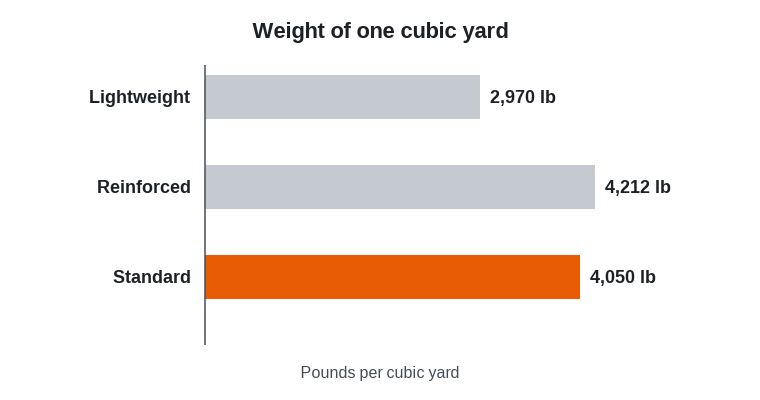
One cubic yard of standard concrete weighs 4,050 lb, about 2.03 US tons, or 1,837 kg. That figure comes from the standard density of normal-weight concrete, 150 lb per cubic foot. The math runs 27 ft³ × 150 lb = 4,050 lb.
Every other weight on this page builds from that same density figure. That includes per square foot of slab, per truck load, and per trailer of broken rubble.
For weights on a specific pour or load, the concrete weight calculator does this arithmetic for your dimensions. The sections below explain the numbers it uses and where they change.
The weight numbers that matter #
Not all concrete weighs 150 lb per cubic foot. Reinforcement adds steel, lightweight aggregate subtracts stone, and broken concrete bulks up with air gaps. Here are the working figures:
| Concrete type | Density | Weight per cubic yard |
|---|---|---|
| Standard (normal weight) | 150 lb/ft³ | 4,050 lb (2.03 tons) |
| Reinforced | 156 lb/ft³ | 4,212 lb |
| Lightweight | 110 lb/ft³ | 2,970 lb |
| Broken / demolished (loose) | ≈89 lb/ft³ loose | ≈2,400 lb (1.2 tons) |
Two more figures that come up constantly on real jobs:
- A 10 × 10 ft slab at 4 inches thick weighs 5,000 lb. The math runs 33.3 ft³ × 150 lb. That total equals two and a half tons of dead load on the ground below it. An elevated slab places that same load on the structure below it.
- Per square foot of slab: a 4-inch slab weighs 50 lb per ft², and a 6-inch slab weighs 75 lb per ft². Multiply by the area any time you need a quick structural or hauling estimate.
Scale those figures up and the numbers get serious fast. A mixer truck with a full 10-yard load hauls 40,500 lb of concrete alone. That figure excludes the weight of the truck itself.
Ready-mix trucks are heavy vehicles with real restrictions on soft ground, fresh driveways and septic fields. The driver gets the final say on where the truck goes.
Wet vs cured: does concrete get lighter as it dries? #
Cured concrete weighs about the same as wet concrete. Curing does not dry concrete the way most people picture it.
When concrete cures, the water in the mix reacts chemically with the cement in a process called hydration. Much of that water becomes part of the hardened cement paste rather than evaporating.
Some water does leave through bleed water at the surface and slow evaporation over the following weeks. The total mass lost stays small compared with the 4,050 lb in a yard.
For any practical purpose, wet and cured standard concrete both weigh about 150 lb per cubic foot. That covers structural design, hauling, ordering, and disposal.
Do not plan a haul or a structure around the idea that the concrete will be meaningfully lighter next month. It will not be. If a load is too heavy on pour day, it is too heavy when cured.
The volume calculations behind pours like this appear in how much concrete do I need. The densities for different mix designs explain why some mixes sit at the heavy or light end of the range.
The structural angle: dead load #
Engineers call the weight of the structure itself dead load, and concrete dominates it. A 4-inch slab imposes 50 lb per square foot of dead load before a single person, vehicle or piece of furniture is added.
On the ground, that mostly does not matter. Soil does not care whether the slab on it weighs 50 or 75 lb per square foot. The soil only needs proper compaction and even support.
Off the ground, it matters enormously. A concrete slab on an upper floor, deck, parking structure, or rooftop adds a permanent load. The framing below must carry that load forever, plus everything placed on top of it.
Engineers specify elevated slab thickness and reinforcement rather than guessing them. They also engineer the slab instead of improvising it. Swapping a designed lightweight mix (110 lb/ft³, or 2,970 lb per yard) for standard concrete creates a genuine structural problem.
Always tell the engineer before making that substitution. Treat that swap as a structural change, not a harmless substitution.
You might estimate an existing slab load for one of these projects:
- A hot tub
- A safe
- A vehicle lift
- An addition
The per-square-foot figures above give you the starting point. Measure the thickness first. Use 50 lb/ft² at 4 inches or 75 lb/ft² at 6 inches, then add the weight of your load.
Hauling and demolition math #
Demolition flips the problem. You haul concrete out instead of ordering it in. Broken concrete weighs less per yard than solid concrete, but it still weighs far more than people expect.
Broken, demolished concrete heaped loose in a trailer or dumpster runs about 2,400 lb per cubic yard (1.2 tons). The chunks do not fit together, so the pile weighs less per yard than solid concrete. A third or more of a loose pile is air.
Even so:
- A half-ton pickup with a payload of 1,500 to 2,000 lb can legally carry roughly 0.4 to 0.5 cubic yards of broken concrete. That pile looks like it should fit easily in the bed. Volume is not the limit; weight is.
- A 10 × 10 ft, 4-inch slab breaks out to 1.23 yd³ of solid concrete. That volume bulks to roughly 1.5 to 2 loose yards in a trailer, or 3,600 to 4,800 lb of rubble. Plan on several pickup loads, one properly rated trailer load, or one small dumpster.
- Rental companies price dumpsters and disposal by weight as much as by size. Concrete is dense enough that a large dumpster can hit its weight limit while looking half empty. Tell the rental company it is concrete before they drop the box, and confirm the included tonnage.
Plan the haul before you start breaking. A rented breaker breaks a slab apart in an afternoon. Moving two tons of rubble with an undersized trailer takes the rest of the weekend.
If you replace the old slab, read how much a concrete slab costs for the cost side of that job.
How density varies #
The 150 lb/ft³ standard figure assumes normal-weight aggregate (ordinary gravel or crushed stone) and a typical mix. Real concrete varies for three main reasons:
- Aggregate type. Aggregate makes up most of the weight. Dense stone pushes density toward the top of the range. Lightweight aggregates such as expanded shale or clay bring a mix down toward 110 lb/ft³, which suits elevated work.
- Reinforcement. Steel rebar and mesh add weight without adding volume. Engineers figure reinforced concrete at 156 lb/ft³, or 4,212 lb per yard, for exactly that reason.
- Air content. Air-entrained mixes, standard for exterior flatwork in freeze-thaw climates, deliberately include tiny air bubbles that improve durability and shave a small amount of density.
For ordering, estimating and hauling, 150 lb/ft³ remains the right default. Use 156 for heavily reinforced work. Use the lightweight figure only when the mix carries a lightweight specification.
Use 2,400 lb per loose yard when the concrete is already broken. When the load really matters, enter your exact dimensions in the concrete weight calculator. Do not round in your head for a trailer at its limit or a floor with a rated capacity.