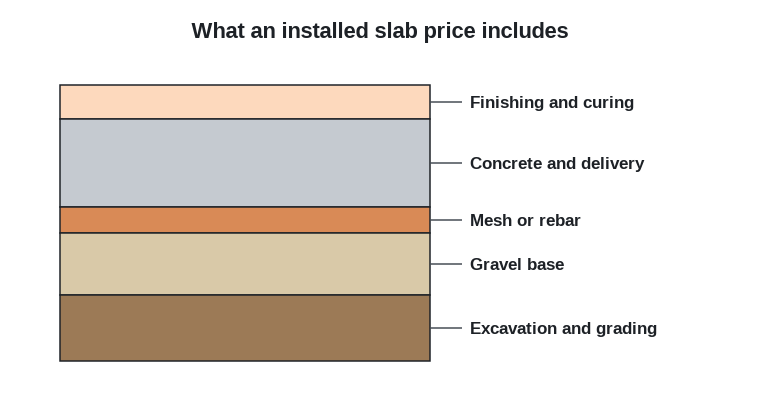
A concrete slab costs $6 to $12 per square foot installed with a basic broom finish. A hired 10 × 10 ft slab therefore runs $600 to $1,200. The concrete itself for that slab costs about $231 in materials for a DIY pour.
Stamped or decorative work raises the installed range to $12 to $20 per square foot. The gap between material cost and installed cost is labor and site work. Every slab quote is really decided in that gap.
Use the concrete slab cost calculator for a cost estimate on your exact dimensions. The breakdown below shows what goes into the number.
Every example uses ready-mix at $170 per cubic yard. The calculator examples use the same rate.
Material cost by size (concrete only) #
These figures cover concrete only, at 4 inches thick, including a waste allowance, at $170 per cubic yard. They exclude gravel base, forms, and reinforcement. They exclude tools too.
Those items come later in this page. They mark the difference between a material quote and a project budget.
| Slab size (4 in thick) | Concrete with waste | Material cost at $170/yd³ |
|---|---|---|
| 10 × 10 ft | 1.36 yd³ | $231 |
| 12 × 12 ft | 1.96 yd³ | $333 |
| 16 × 16 ft | 3.48 yd³ | $591 |
| 20 × 20 ft | 5.43 yd³ | $923 |
| 24 × 24 ft | 7.82 yd³ | $1,330 |
The standard calculation produces the yardage. Workers multiply length by width by thickness in feet, divide by 27, and add waste. The guide how to calculate concrete for a slab walks through the calculation step by step.
Two worked comparisons show how delivery details change the material bill:
- 12 × 12 patio, 4 inches: Ready-mix costs 1.96 yd³ with waste at $170/yd³, or $333. A short-load fee often applies to small loads and pushes the same pour to around $408. Bags instead cost 88 × 80 lb bags at $5.50, or $484, plus a full day of mixing. Below two yards, price both ways. The short-load fee and the bag price punish you in different ways.
- 20 × 20 garage slab: Hiring it out at $8 per ft² installed costs 400 ft² × $8 = $3,200. The concrete in it costs 5.43 yd³ with waste at $170, or $923. Everything between those two numbers is the contractor's work below.
What the contractor price includes #
A quote at $6 to $12 per square foot does not mark up $231 of concrete heavily. The quote pays for a sequence of jobs. Each job carries its own labor and materials:
- Excavation: digging out the slab area to depth and hauling spoil away.
- Gravel base: material, delivery, spreading and compacting the base the slab sits on.
- Forms: lumber, stakes and the labor to set them level and square.
- Reinforcement: rebar or wire mesh, chairs and tying.
- The pour: the concrete itself, the crew, and placing it before it sets.
- Finishing: screeding, floating and the broom or trowel finish.
- Control joints: cut or tooled joints that decide where the slab cracks, because it will crack somewhere.
- Curing: compound or covering, and the return visit some contractors make for it.
Get quotes itemized. Ask each contractor to confirm in writing that every item above is included. The cheapest quote is often cheapest because one line quietly shrank.
Contractors usually shrink the base depth or the reinforcement. A thin, uncompacted base is the most expensive saving in concrete work. The slab looks identical on day one and settles within two winters.
Extras that add up #
Beyond the base installed price, these additions most often surprise people:
- Tearing out the old slab: Removal and disposal of existing concrete costs $1 to $3 per square foot. The work is heavy and slow. Broken concrete runs about 2,400 lb per loose cubic yard, as how much concrete weighs details, and dump fees follow the weight.
- Pumping: A pump adds a flat fee when a mixer truck cannot reach your forms. That fee can rival the concrete cost on a small pour.
- Stamped or decorative finish: This finish moves the installed price from the $6 to $12 range into $12 to $20 per square foot. It also adds sealing to your maintenance list.
- Thicker slabs and thickened edges: A 6-inch driveway slab uses 50% more concrete than the 4-inch figures above. A garage slab with thickened edges uses more still.
- Permits and inspections: Many jurisdictions require permits for structural slabs. The locality prices them, not the contractor.
The failure mode is discovering these costs after you budget to the base per-foot price.
The true DIY cost #
DIY material cost is real, but materials covers more than the concrete line in the table above. A first-time DIY slab also includes:
- Form lumber and stakes: reusable with another pour coming, but a sunk cost without one.
- Gravel base: delivered or hauled material, plus a compactor rental for proper compaction.
- Reinforcement: mesh or rebar, plus rented cutters or a grinder disc.
- Tool rental: a drum mixer for bag work, plus floats, a screed board, an edger, and a wheelbarrow you do not own.
- Your weekend: A 10 × 10 slab takes a full day for two experienced people, and a longer one for two beginners. Concrete does not wait while you learn. A botched finish is permanent.
Priced honestly, DIY still wins clearly on small slabs. A 10 × 10 needs roughly $231 of concrete plus base and forms, against $600 to $1,200 hired. That saving is genuine.
The crossover is about risk, not just money. At 20 × 20, placing and finishing 5.43 yards before it sets is a crew job. The $3,200 installed price buys people who do it every week.
Many homeowners split the difference. They handle excavation, base, and forms themselves, then hire a finisher for pour day.
Regional variation #
Every figure on this page is a national-range estimate. Slab prices move with local conditions. Ready-mix at $170 per cubic yard is a reasonable planning figure.
The per-yard price, short-load fees, and delivery charges vary by market and by distance from the plant. Labor varies more, and labor forms the larger half of an installed price. An $8 per ft² quote in one region becomes $12 in a high-cost metro for the identical slab.
Rural areas with few concrete contractors can price like cities. The crew drives an hour to reach you.
Use the table for budgeting and comparison, and get at least two local quotes for a hired slab. Put your own dimensions into the concrete slab cost calculator. The calculator returns a material figure from your measurements rather than a generic size.
If you are still deciding between bags, site mixing and ready-mix, check the cost trade-off per yard. How many bags of concrete are in a yard sets it out in full. The volume guide how much concrete do I need covers the volume side for every common project shape.