Concrete Sidewalk Calculator
This concrete sidewalk calculator works out cubic yards and bag counts for walkways from three measurements: total length, width, and thickness. Sidewalks are long and narrow, which makes them one of the few pours where bags genuinely compete with a ready-mix truck. So this calculator shows both options side by side.
Free · Instant results as you type · No sign-up
Live preview
Your estimate
Updates as you typeIncludes a 10% waste allowance on top of the exact geometric volume (1.48 yd³). Bag counts are rounded up, because you cannot buy part of a bag.
The defaults match a typical residential walk: 4 ft wide and 4 in thick. Public sidewalks in front of a house often follow city specifications instead, commonly 5 ft wide. They may also need a permit and inspection, so check your local rules before you copy a neighbor's dimensions.
How This Calculator Works
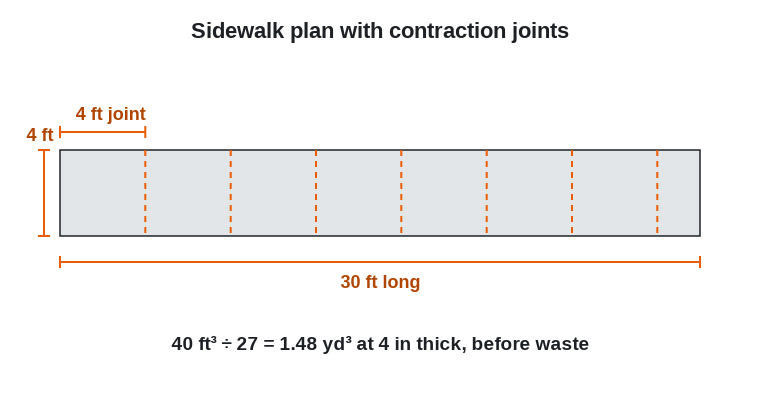
The calculator multiplies length × width × thickness in feet and divides by 27 for cubic yards. A 30 ft sidewalk at 4 ft wide and 4 in thick is 120 ft² × 0.333 ft = 40 ft³, or 1.48 yd³. Bag counts divide the cubic feet by yield, 0.60 ft³ per 80 lb bag, which puts that same walk at 67 bags before waste.
Joints keep a sidewalk from cracking randomly: space contraction joints at a distance equal to the width. That spacing means every 4 to 5 ft on most walks, with expansion joints every 25 to 30 ft and at driveways, steps, and buildings. Slope the surface across its width at about 2%, roughly 1/4 in per foot, so water runs off instead of pooling and icing.
Pour on 2 to 4 in of compacted gravel base with the topsoil stripped out. The base evens out minor soil movement and drains water away from under the slab, which stops panels lifting and cracking in freeze-thaw climates. If this walk sits in the public right-of-way, expect a permit, city thickness and strength specs, and an inspection before the pour.
Formula: Volume = Length × Width × Thickness (all in feet) · Cubic yards = Cubic feet ÷ 27 · 80 lb bags = Cubic feet ÷ 0.60, rounded up
Worked Example: A 30 ft sidewalk, 4 ft wide, 4 in thick
- Convert the thickness: 4 in ÷ 12 = 0.333 ft.
- Multiply: 30 ft × 4 ft × 0.333 ft = 40 ft³.
- Convert to yards: 40 ÷ 27 = 1.48 yd³ exact.
- Add 10% waste: 1.48 × 1.10 = 1.63 yd³ if you order ready-mix.
- In bags: 40 ÷ 0.60 = 67 × 80 lb bags before waste, and 74 bags with the 10% allowance included.
Result: 1.48 yd³ exact (1.63 yd³ with waste), or 67 × 80 lb bags before waste and 74 with waste.
Per 10 Feet of Sidewalk, 4 in Thick
| Width | Cubic feet | Cubic yards | 80 lb bags |
|---|---|---|---|
| 3 ft wide | 10 ft³ | 0.37 yd³ | 17 bags |
| 4 ft wide | 13.33 ft³ | 0.49 yd³ | 23 bags |
| 5 ft wide | 16.67 ft³ | 0.62 yd³ | 28 bags |
Sidewalk Concrete by Length and Width (4 in thick)
Read across for the width of your walk. These are exact cubic yards, so add 5 to 10% before ordering. For a length between rows, add two rows together.
| Length | 3 ft wide | 4 ft wide | 5 ft wide |
|---|---|---|---|
| 10 ft | 0.37 yd³ | 0.49 yd³ | 0.62 yd³ |
| 20 ft | 0.74 yd³ | 0.99 yd³ | 1.23 yd³ |
| 30 ft | 1.11 yd³ | 1.48 yd³ | 1.85 yd³ |
| 50 ft | 1.85 yd³ | 2.47 yd³ | 3.09 yd³ |
| 100 ft | 3.70 yd³ | 4.94 yd³ | 6.17 yd³ |
Curves, Corners and Driveway Crossings
Measure a curved walk along its centerline. A quarter circle bend with a 10 ft centerline radius is 3.1416 × 10 ÷ 2 = 15.7 ft long. Enter that as the length and the volume is right, because the longer outside edge and shorter inside edge cancel out.
At a right-angle corner, measure one leg to the outside edge and stop the other leg where it meets the first. Measuring both legs to the outside counts the corner square twice. On a 4 ft walk, 4 in thick, that is 5.33 ft³, or nine 80 lb bags.
Where the walk crosses a driveway, calculate that stretch separately at 6 in. A 12 ft crossing on a 4 ft walk takes 24 ft³ at 6 in against 16 ft³ at 4 in, so budget an extra 8 ft³, or 0.30 yd³.
Pouring a Sidewalk in Sections With Bags
A walk splits naturally at its joints, which makes it a manageable bag job. A 4 × 4 ft panel, 4 in thick, is 5.33 ft³, or nine 80 lb bags. You can place and finish a few panels, put a bulkhead across the forms at a joint, and carry on another day.
The 30 ft walk in the worked example is seven full panels and one half panel. Pouring by panel rounds up on each one, so the total is 68 bags instead of 67 before waste. Always stop at a planned joint. Stopping mid-panel leaves a weak line exactly where you do not want a crack.
Gravel Base for a Sidewalk
Base gravel uses the same length × width × depth math. A 30 × 4 ft walk over 4 in of gravel needs 40 ft³, or 1.48 yd³, measured compacted. Loose gravel settles when compacted, so allow about 10% more and check the tonnage in the gravel calculator.
Dig deep enough for both layers. A 4 in walk on 4 in of gravel finishing 1 in above the lawn needs a 7 in excavation: 8 in of layers minus the 1 in left showing.
Width and Slope for Accessible Walks
Private garden paths have few rules, but public and commercial walks must meet accessibility standards. The federal 2010 ADA Standards set a minimum clear width of 36 in, a maximum cross slope of 1:48 (about 2%), and a maximum running slope of 1:20 (5%) before the route counts as a ramp. Routes narrower than 60 in also need passing spaces at least every 200 ft.
A 1:48 cross slope equals 1 in of fall over a 4 ft width. Set one form board 3/4 to 7/8 in lower than the other, so small errors still land under the limit. Cities often require more width than the federal minimum, so check the local detail before forming.
Frequently Asked Questions
How many bags of concrete do I need for 10 ft of sidewalk?
For a 4 ft wide, 4 in thick section, 10 ft of sidewalk is 13.33 ft³, which takes 23 × 80 lb bags. A 3 ft wide walk takes 17 bags and a 5 ft wide walk takes 28 bags for the same 10 ft length.
How thick should a sidewalk be?
Four inches is standard for residential sidewalks and walkways. Use 5 to 6 in where the walk crosses a driveway or carries vehicle loads, because that panel takes wheel weight, not just foot traffic.
How far apart should sidewalk joints be?
Space contraction joints roughly the walk's width apart: every 4 ft on a 4 ft walk, every 5 ft on a 5 ft walk. Add expansion joints every 25 to 30 ft and at driveways, steps, and buildings where the walk meets another structure.
Can I pour a new sidewalk over an old one?
No. New concrete bonded over an old, cracked walk copies the cracks through, sits too high at doorways and driveway crossings, and fails early. Remove the old walk, re-compact the base, and pour fresh at full thickness.
How much does a concrete sidewalk or patio cost in material?
Use this as a concrete sidewalk cost calculator: the 30 ft walk is 1.63 yd³ with waste, about $285 in ready-mix at $175 per yard. Pre-mix costs roughly $407 for 74 bags at about $5.50 each, while hired-out walks and patios typically run $6 to $12 per square foot installed. Patios use the same math: a rough concrete patio cost calculator for material only, and the slab calculator is the true concrete patio calculator.
Do I need a permit for a sidewalk?
A walk entirely on your own property usually needs no permit. A sidewalk in the public right-of-way, the strip between the street and your lot line, typically does need one. The city may dictate width, thickness, and mix strength, and require an inspection before you pour.
Related Calculators
Helpful Guides
Concrete Bags
How Many Bags of Concrete for a 10x10 Slab? (+ Common Slab Sizes)
How many bags of concrete for a 10x10 slab? A 4 inch slab needs 56 bags of 80 lb mix, or 62 with waste. See the size chart and thickness math.
Read guideSlab & Flatwork
How to Calculate Concrete for a Slab
Calculate concrete for any slab: convert thickness to feet, multiply, divide by 27, add waste. Worked example, size chart and the subgrade mistake to avoid.
Read guideSlab & Flatwork
How Thick Should a Concrete Slab Be? (4 in vs 6 in)
Four inches for patios, 5 to 6 for driveways and garages, but base quality beats extra thickness. Thickness table, the 2x4 trap and what extra costs.
Read guide