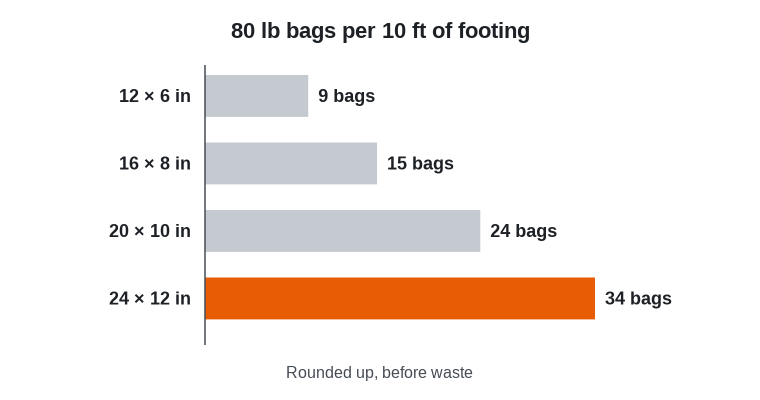
A common 16 in wide by 8 in deep strip footing needs 15 bags of 80 lb concrete mix per 10 linear feet. That section holds 8.89 cubic feet of concrete, and each 80 lb bag makes 0.60 cubic feet when mixed.
The math is 8.89 divided by 0.60, rounded up to the next whole bag.
Smaller and larger footings change the count fast. A light 12 in by 6 in footing takes 9 bags per 10 feet. A 24 in by 12 in footing takes 34 bags for the same length.
Measure your actual trench width and depth before you buy. Run your own length through the footing calculator. Buy for the footing you dug, not the one you planned on paper.
Strip footing bag chart #
Strip footings run in a continuous line under walls, decks, and additions. The cross-section stays the same along the run. Estimate per 10 feet, then multiply by your total length.
| Footing size (width x depth) | Concrete per 10 ft | 80 lb bags per 10 ft |
|---|---|---|
| 12 in x 6 in | 5.00 ft³ | 9 |
| 16 in x 8 in | 8.89 ft³ | 15 |
| 20 in x 10 in | 13.89 ft³ | 24 |
| 24 in x 12 in | 20.00 ft³ | 34 |
Divide your footing length by 10 to use the chart. Multiply by the bags in the row matching your section, then round up.
A 30 ft run of 16 in by 8 in footing equals three chart units. It needs 45 bags before any allowance for an uneven trench bottom.
That uneven bottom matters. Hand-dug trenches rarely hold an exact depth. A section that runs deep consumes more concrete than the chart allows.
Measure the deepest typical section and keep a few extra bags on hand. You can usually return unopened bags. You cannot pause a short pour while you drive to the store.
Spot and pier footings #
Not every footing is a strip. Deck posts, pergola posts, and small structures often sit on individual round piers. Crews pour these spot footings in holes or tube forms.
A single pier 12 in in diameter and 3 ft deep holds 2.36 cubic feet of concrete. Dividing by 0.60 cubic feet per 80 lb bag gives 4 bags per pier. Multiply by the number of piers in the layout.
Four piers need 16 bags, and six piers need 24 bags. Add extra for holes that bell out or run deep.
Piers look small on a plan, but their depth adds up. Most pier volume sits below grade where you cannot see it. Guessing from the visible top badly underestimates the job.
Measure the drilled or dug depth, not just the part above ground. Check each hole if the digging was uneven. A run of piers is rarely perfectly uniform.
For a mixed project, add the strip and pier volumes together first. Convert the total to bags once.
That method beats rounding up each element separately, which quietly inflates the count. The guide to how much concrete you need walks through that volume-first approach for other shapes too.
A whole-house example: when the count stops making sense #
Take a simple 40 ft by 30 ft house. Its perimeter runs 140 linear feet of footing. At the common 16 in by 8 in section, that footing holds 0.889 cubic feet per linear foot.
The full perimeter therefore holds 124.4 cubic feet of concrete.
Converted, 124.4 cubic feet equals 208 bags of 80 lb mix, or 4.61 cubic yards. Workers must buy, load, and haul those 208 bags, then unload them at the trench. They open, mix, and place each bag one batch at a time, while earlier batches start setting.
A ready-mix truck carries the identical concrete in a single load.
This extreme case is the classic bags-or-truck edge case, and the answer is not close: order the truck for a full house footing. A 40 ft run of the same 16 in by 8 in section sits right on the edge. It holds 35.56 cubic feet, which is 60 bags or 1.32 cubic yards.
Sixty bags is a hard day of mixing but a plausible one for a small crew. Two hundred eight bags is not a plan. It is a week of labor for a worse result.
Use the house example as your scale check. If your footing total lands anywhere near triple figures in bags, stop pricing bags. Price a delivery instead.
When bags do make sense for footings #
Bags are the right call for footings that are small, remote, or hard to reach with a truck. Typical bag-sized footing jobs include:
- A shed base or a small deck, where a handful of piers or a short strip is the whole job
- A short footing for a garden wall, a small addition bump-out, or a porch repair
- A site with no truck access, where concrete has to move by wheelbarrow from the driveway anyway
- A repair or extension to an existing footing, where only a few feet need pouring
Total volume is the common thread, not the type of footing. Jobs measured in a few cubic feet belong in bags. Jobs measured in cubic yards belong on a truck.
The middle ground is roughly that 40 ft run and its 60 bags. The deciding factors are crew size, how far the mix must travel, and whether a truck can reach the site at all.
Stage bags along the trench before you start if you use them. Keep them dry and off the ground. Mix as close to the pour as possible.
Footings reward a steady, continuous pour. Running back and forth for bags breaks that rhythm. See the concrete bag calculator for the general bag math behind any size.
Footing basics that affect the count #
Three basics decide whether the bags you bought actually do their job.
First, a footing must sit below the local frost depth. Winter freezing and thawing can otherwise lift it.
Your local code sets that depth. The same depth sets pier depth on many jobs.
Second, a footing should bear on undisturbed soil. Loose backfill and disturbed trench bottoms compress under load. Dig to firm ground and keep the bottom as flat and level as you can.
Soft spots dug out and refilled loosely eat extra concrete. They still perform worse than a clean, firm base.
Third, width is not arbitrary. The footing spreads the wall's load over enough soil to carry it. Wider walls and heavier structures therefore get wider footings.
That sizing explains why the chart jumps from 9 bags to 34 bags per 10 feet. Read concrete footing calculations explained for the rules behind footing width, depth, and sizing before you dig.
Measure twice, convert your total volume once, and round up to whole bags.