Concrete Block Calculator
This concrete block wall calculator turns your wall length and height into the two numbers a block order needs: CMU count and mortar bags. It covers foundation walls, retaining walls, garden walls, and garage and outbuilding walls built with standard 8 × 8 × 16 in block. Enter the wall dimensions, and the block count, mortar estimate, and waste allowance update together.
Free · Instant results as you type · No sign-up
Live preview
Your estimate
Updates as you typeCounts include the waste allowance you set and a standard 3/8 in mortar joint. Mortar yield: one 80 lb bag lays about 37 standard blocks.
Block math trips people up because the block on the pallet is not the size on the label. A standard block measures 16 × 8 in nominal and 15.625 × 7.625 in actual, and the missing 3/8 in is the mortar joint. The nominal size includes the joint, so one block face covers exactly 16 × 8 in of wall and the coverage rule stays exact.
How This Calculator Works
Each block with a 3/8 in joint covers 16 × 8 in of wall face (128 in², or 0.889 ft²): 1.125 blocks per square foot. The calculator multiplies your wall area by 1.125 and adds the waste allowance, 5% by default, for cuts, breakage, and half blocks. Subtract door and window openings from the wall area first if the wall has large openings.
The calculator estimates mortar from laid block yield, not wall area, because joints consume it. One 80 lb bag of pre-mixed mortar lays about 37 standard blocks.
The calculator divides your block count before waste by 37 and rounds up. A 60 lb bag lays about 28, and yield drops when joints run fat or blocks sit out of level, so buy an extra bag.
Know the block types before you order. The standard unit is the 8 in wide stretcher block, and most 8 in walls use it. Widths of 4, 6, 10, and 12 in serve thinner partitions and heavier structural walls.
Half blocks (8 × 8 × 8 in) finish ends and corners without cutting full units on every other course. This calculator counts standard full blocks, so add a few percent more waste if your design uses bond beams, lintel blocks, or heavy cutting.
Structural walls also need vertical and horizontal reinforcement and grout fill in the cells. A common specification fills cells every 4 ft and at every vertical rebar. That grout volume is a separate estimate on top of the block and mortar counts here.
Formula: Wall area = Length × Height · Blocks = Area × 1.125 · Mortar bags (80 lb) = Blocks ÷ 37, rounded up
Worked Example: A 20 ft long × 8 ft high block wall
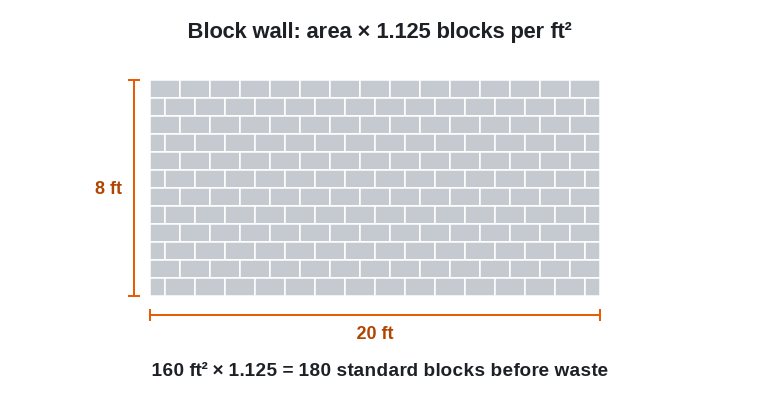
- Wall area: 20 ft × 8 ft = 160 ft².
- Blocks: 160 × 1.125 = 180 blocks exactly, before waste.
- Mortar: 180 ÷ 37 = 4.86, which rounds up to 5 × 80 lb bags of mortar.
- With the default 5% waste allowance, the tool shows 189 blocks. Order 189 to 190 to cover cuts and breakage.
Result: 180 blocks exact (189 with 5% waste) and 5 × 80 lb bags of mortar for a 20 × 8 ft wall.
Blocks and Mortar for Common Wall Sizes (before waste)
| Wall size | Area | Blocks | Mortar 80 lb bags |
|---|---|---|---|
| 10 × 4 ft | 40 ft² | 45 | 2 |
| 20 × 8 ft | 160 ft² | 180 | 5 |
| 40 × 8 ft | 320 ft² | 360 | 10 |
| Per 100 ft² | 100 ft² | 113 | 4 |
Frequently Asked Questions
How many concrete blocks do I need per 100 square feet?
Exactly 112.5 blocks cover 100 ft² at 1.125 blocks per square foot, so order 113 blocks before waste. With a typical 5% waste allowance for cuts and breakage, plan on about 118 blocks per 100 ft² of wall.
How much mortar do I need for 100 blocks?
One 80 lb bag of mortar lays about 37 standard blocks with 3/8 in joints, so 100 blocks take 100 ÷ 37 = 2.7 bags. Buy 3 × 80 lb bags. In 60 lb bags (about 28 blocks each) the same 100 blocks take 4 bags.
What sizes do concrete blocks come in?
The standard CMU measures 8 in high × 16 in long nominally, in widths of 4, 6, 8, 10, and 12 in. Actual dimensions run 3/8 in smaller in each direction (7.625 × 15.625 in), which leaves room for the mortar joint. Half blocks, nominally 8 × 8 in, finish ends and corners, and most walls use the 8 in width.
Is a cinder block the same as a concrete block or CMU?
In everyday use, yes: 'cinder block', 'concrete block', and 'CMU' (concrete masonry unit) all name the same standard gray block. This calculator gives the same count for any of them. True cinder blocks used coal ash, while modern units use Portland cement and aggregate and are stronger and more consistent.
Can this work as a concrete block fill calculator?
Use this estimate for fill volume: grouting every cell of standard 8 × 8 × 16 block takes roughly 0.85 yd³ per 100 blocks. Most structural walls fill only the cells that carry vertical rebar, commonly every 4 ft, or about one cell in six. That pattern takes a sixth of the fill volume, so divide the block count from this page by 100 and multiply by your pattern's figure.
How much does a concrete block wall cost?
This page counts blocks rather than acting as a concrete block wall cost calculator, but the count converts to cost quickly. Blocks typically run $1.50 to $2.50 each, and an 80 lb bag of mortar costs about $6 to $8 and lays roughly 37 blocks. The 180-block wall above runs roughly $300 to $500 in materials, and a mason-laid wall typically totals $10 to $20 per square foot installed.
How many concrete blocks come on a pallet?
A pallet typically holds 90 to 120 blocks depending on size, and about 90 is a common count for standard 8 in blocks. Suppliers price full pallets lower per block and charge a refundable pallet deposit. Round your order up to full pallets when the count is close.
Related Calculators
Helpful Guides
How-To Guides
Concrete Walls With Openings: Subtracting Doors & Windows
Wall concrete = gross volume minus every door and window void at wall thickness. Two worked examples where openings save over a full yard of concrete.
Read guideConcrete Bags
How Many Bags of Concrete for a Retaining Wall?
Retaining wall bags of concrete: an 8 inch wall 3 feet high takes 34 bags of 80 lb mix per 10 feet, plus 30 for the footing. See charts.
Read guide