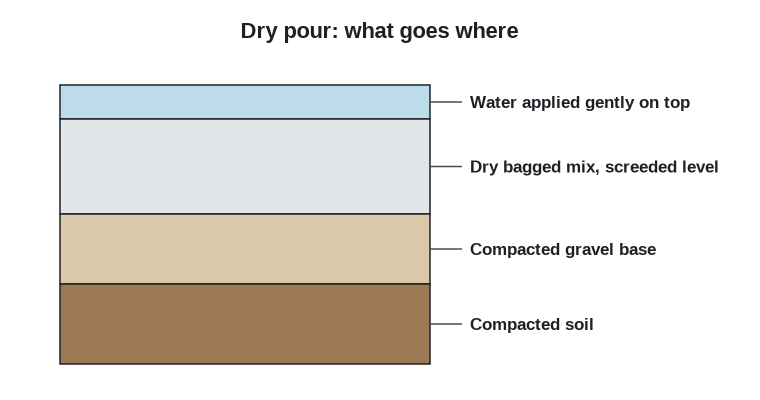
Dry pour concrete means spreading dry pre-mix in the forms and leveling it. You then add water by misting and soaking, instead of mixing concrete wet before you place it. It works, after a fashion, for a small garden pad.
It is not a shortcut to real concrete. Independent tests and engineer consensus consistently find dry-poured slabs weaker and less consistent than properly mixed concrete. Hydration runs uneven from top to bottom.
It also saves no material at all. A 10 x 10 pad at 4 inches needs the same 56 bags of 80 lb pre-mix whether you mix it or dry pour it.
That honest framing matters because the method is genuinely popular. Know where the method is acceptable, and where crews must not use it. That knowledge is the difference between a cheap shed base and a driveway that fails in two winters.
What the dry pour method is #
In a conventional pour, crews combine dry ingredients and water in a mixer or truck drum until the concrete is uniform. They then place, screed, and finish it. Every part of the slab starts with roughly the same water content and the same proportions.
In a dry pour, crews dump the bagged pre-mix into the forms dry, screed it level, and edge it. Crews then apply water from above: a gentle misting first so the surface does not wash out, followed by repeated soakings over hours. The idea is that water migrates down through the dry mix and hydrates the cement in place.
The quantity math does not change. Dry pour changes placement, not volume. The 10 x 10 pad at 4 inches is 33.33 cubic feet either way.
That is the same 56 x 80 lb bags the homepage calculator calculates. Anyone who tells you dry pouring stretches your material is selling you a thinner slab.
The honest strength discussion #
Concrete gets its strength from hydration (cement reacting with water) and from that reaction happening evenly, with the right amount of water. Dry pouring struggles on both counts.
The top of a dry-poured slab tends to be over-wet. It receives every application of water first.
Excess water means a higher water-to-cement ratio, which means weaker, softer concrete that can dust and scale at the surface. Meanwhile the core and bottom can stay under-hydrated: water slows as it moves down, the mix is not agitated, and pockets can remain effectively dry. Dry pockets do not gain strength at all, and they become voids and weak planes inside the slab.
Because crews never mix the material, they also have no way to verify consistency. One bag's worth of material may differ from the next area over.
Properly mixed concrete, whether from a truck or a rented mixer, is uniform by comparison. That uniformity makes its strength predictable enough to specify and inspect.
Side-by-side independent tests of dry-poured versus mixed slabs support this engineer consensus position: the dry-poured versions show lower and less consistent strength. For a pad carrying a compost bin, that may not matter. For anything structural, it disqualifies the method outright.
Where it works and where it must not be used #
| Use | Dry pour? | Why |
|---|---|---|
| Small garden or walkway pad | Acceptable | Light loads, low consequence if it cracks |
| Shed base for light storage | Acceptable, with care | Distributed light load on a small footprint |
| Trash bin or AC pad | Acceptable | Small, non-structural, easy to replace |
| Driveway | No | Vehicle loads need full, consistent strength |
| Footings carrying load | No | Structural: failure is hidden and serious |
| Anything covered by code or permit | No | Cannot be inspected or verified as mixed concrete |
| Garage or workshop slab | No | Point loads and long service life required |
The pattern is simple: dry pour only where the slab is small, flat, non-structural, and cheap to tear out if it disappoints. The moment loads, vehicles, a structure, or a building code enter the picture, mix the concrete.
Surface quality belongs in the decision too. Dry-poured surfaces are more prone to dusting and scaling, and voids can appear at edges where water did not fully penetrate. A pad that people see and walk on daily deserves the finish that only wet placement and proper curing give.
Step-by-step: a small pad, done as well as it can be #
If your project is in the acceptable column, do the method carefully. Most dry pour failures come from rushing the watering, which is the entire point of the method.
- Build forms and prepare the base exactly as for a wet pour. The method forgives nothing about a soft or uneven base.
- Calculate bags from volume (for example with the homepage calculator) and stage all of them before you start.
- Spread the dry pre-mix evenly and screed it level, working it into corners and edges so there are no loose pockets.
- Edge the pad while dry, carefully, and remove spilled dry mix from the edges.
- Mist the surface gently until it is evenly damp. Do not flood it; a hard stream washes cement out of the top layer.
- Soak in stages over several hours, letting each application absorb before the next, until the full depth has taken water. This staged soaking is not optional: it is the only mechanism the slab has.
- Cover and cure. Keep the pad covered and damp after the initial soaking so hydration continues instead of the surface drying out.
Even done perfectly, expect a serviceable utility pad, not a showpiece slab.
The post-hole exception: dry-pack is different #
One dry method is legitimate and manufacturer-approved, and people often confuse it with dry-pouring slabs. Crews commonly set fence or deck posts with fast-set concrete.
They pour dry mix into the hole around the post and add water per the bag's instructions. That is dry-pack post setting, not a dry-poured slab.
The manufacturer designs and labels that product and procedure for that specific use. The concrete stays confined in the hole, and the load path is completely different. Using a fast-set post method as evidence that dry-pouring a driveway will work mixes up two different techniques.
Verdict #
Dry pour is fine for a garden pad, a bin base, or a small shed floor where failure is an inconvenience. It is wrong for a driveway, a footing, or anything structural or code-covered, because the strength is lower, uneven, and unverifiable. If you do dry pour, soak thoroughly in stages over hours, edge carefully, and cure covered.
If the slab matters, rent the mixer or order the truck, and calculate the volume either way with how much concrete do I need.