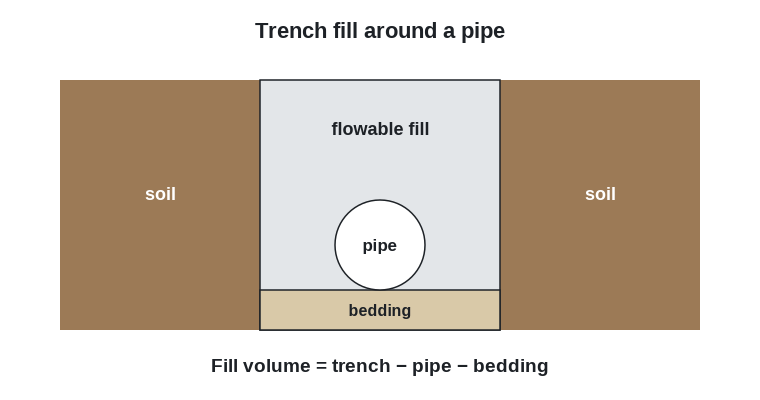
A trench takes length x width x depth of material to fill. A 50 ft long, 2 ft wide, 3 ft deep utility trench holds 300 ft3, or 11.11 yd3. Flowable fill is the material many utilities now require for that job.
Flowable fill is a cement slurry that firms up with no compaction. Its diggable grades typically run 50 to 150 PSI. It flows into every void and then sets.
Tank pads use ordinary concrete. A round pad 12 ft across and 6 in thick takes 2.09 yd3.
Trench math: length x width x depth, then average end areas #
For a clean, uniform trench, volume is the box it forms: length x width x depth, all in feet. The standard example is a utility trench 50 ft long, 2 ft wide, and 3 ft deep: 50 x 2 x 3 = 300 ft3. Divide by 27 for cubic yards: 300 / 27 = 11.11 yd3.
That is the quantity before you adjust for what else occupies the trench.
Real trenches are rarely perfect boxes. One end may sit deeper to hold a slope for a drain line. Walls may slough in soft soil, and depth may change at utility crossings.
For a varying cross-section, estimators use the average-end-area method. Add the cross-sectional areas of the two ends and divide by two. Then multiply by the length between them.
Worked example: a trench section 20 ft long has an end area of 6 ft2 at one end and 8 ft2 at the other. The average is (6 + 8) / 2 = 7 ft2. Volume is 7 x 20 = 140 ft3, which is 140 / 27 = 5.19 yd3.
For a long trench, break it into segments, apply the method between measured cross-sections, and add the segments. More segments where the shape changes fastest means a more honest total.
Measure depth from where the fill actually starts. If bedding sits at the bottom, fill depth starts above it. Expect the dug trench to exceed the drawn one, because buckets over-dig and sides ravel.
The same math applies where fill will be concrete, such as an encasement or duct bank. See how much concrete you need.
Tank pads: round volume, and what goes under the tank itself #
A pad for a round tank is a flat cylinder: pi x radius squared x thickness. Worked example: a pad 12 ft in diameter and 6 in thick.
The radius is 6 ft, and the thickness is 0.5 ft. Volume is pi x 6^2 x 0.5, which equals pi x 36 x 0.5, or 56.5 ft3. In yards, 56.5 / 27 = 2.09 yd3.
Crews size the pad to the tank. The pad extends beyond the footprint for stability and access. It is ordinary flatwork, essentially a slab with a circle on the plan.
A septic or water tank typically does not sit on concrete at all. Crews set it on a bed of sand or pea gravel, typically 6 in under the tank. They level the bed so the tank bears evenly and does not rock or settle on a point.
Do not pour a concrete slab under a tank because it feels more substantial, unless the tank manufacturer's instructions or local code call for one. Follow the tank installation specification for bedding material and depth. Keep concrete for pad applications, such as equipment pads and access pads around the installation.
Flowable fill: what it is and when utilities require it #
Flowable fill, also called CLSM or controlled low-strength material, is a cement slurry backfill. Plants sell it by the yard, like concrete. Crews order it from the ready-mix plant.
Flowable fill is not concrete, and crews should never treat it as structural material. It flows like a thick liquid and fills every void in a trench. It hardens just enough to behave like well-compacted soil.
Excavatable flowable fill is the grade crews specify most often for utility trenches. It typically runs 50 to 150 PSI. That low strength is a feature, not a flaw.
A future crew can dig through it with a machine when the utility needs repair. Crews can dig it almost as easily as soil. It avoids jackhammering through concrete.
Structural grades go up to about 300 PSI. Crews use them where more support matters and future excavation matters less. Flowable fill is engineered fill, and trucks deliver it.
Utilities and road authorities require flowable fill in specific situations:
- Trenches under pavements, where poor compaction would settle and damage the road surface
- Trenches around pipes that cannot tolerate compaction equipment
- Narrow or irregular excavations where lift by lift compaction is impractical
Labor saving drives the requirement. A crew places the fill, and it flows into place and self-levels. Nobody compacts, and crews can often pave or open the trench sooner.
That convenience carries two disciplines. First, the fill is fluid and buoyant. Crews must restrain or weight pipes and tanks so they do not float as fill rises.
Crews sometimes stage placements for the same reason. Second, flowing fill finds every leak path out of the excavation. Seal the ends and low spots, or part of your ordered yardage will fill the wrong place.
Never substitute flowable fill where a design calls for concrete. Never use concrete where a utility specified flowable fill. The first error weakens a structure, and the second buries a utility under material crews cannot dig through.
Bedding rules of thumb and ordering notes #
Pipes, tanks, and trenches share one principle: what touches the buried object matters. Pipe bedding supports the pipe evenly along its length. Cover material around and over a pipe protects it from rocks and damage during backfill placement.
Utility work almost always follows a specification. The spec sets:
- Bedding material and depth
- Cover material
- How far the careful zone extends around the pipe
Follow it exactly.
On private work done to rules of thumb, crews follow consistent habits:
- Bed evenly
- Keep large rock away from the pipe
- Never drop chunky excavated material directly onto a new line
For tanks, repeat the bedding rule: typically sand or pea gravel, typically 6 in under the tank, leveled.
For trench backfill, the pipe and its bedding occupy part of your calculated volume. On small trenches, displacement is minor and most estimators let waste judgment absorb it. On short, large-diameter runs, subtracting displacement can be worthwhile.
Know which convention your number uses before you order.
Ordering flowable fill has practical notes. Order it from the ready-mix plant by the yard. Order by name, flowable fill or CLSM, and by grade, excavatable or structural.
That way the plant hears the strength intent, not just the product name. Ask about minimum load sizes and short-load fees when you order. A 5.19 yd3 trench segment can fall between a small load and an economical one.
Coordinate timing before the truck arrives. Confirm each item first:
- The trench is open
- Inspectors have inspected it, if required
- Pipes are restrained
- Ends are sealed
Close the job by recording what actually went in. Record trench volumes, the grade of fill used, and pad dimensions. Buried work disappears the day crews finish it, so written numbers help the next crew.